
 AI Agent ROI Calculator
 Free training: Chatbot crash course
 Whitepaper: The acceptance of chatbots
The best voicebots for customer service in 2026:8 tools compared
We analyze the leading providers for 2026 and show you which voicebot is best for your requirements, enabling you to implement a future-proof service strategy.
In 2026, modern AI voicebots have rehabilitated the phone call as an efficient customer service channel by understanding natural language in real time and resolving complex issues conclusively. In this voicebot comparison for customer service in 2026, we evaluate the eight leading providers in terms of complexity, flexibility, and the option for human handover. We show you which systems are truly reliable for automated support by phone.
The strategic relevance of voicebots for 2026 is underpinned by massive market changes and current study data: In its latest Predicts 2026, Gartner estimates the potential savings from conversational AI in contact centers at around $80 billion in personnel costs worldwide. Voicebots take on the role of "first-line defenders," handling standard inquiries without any wait time. Market data from cmm360 (Trends 2026) shows that voice AI is becoming the preferred channel for complex scenarios. While simple questions are often resolved via chat, customers seek conversation for urgent or emotional concerns. The latest generation of voicebots already achieve containment rates of over 70% without the need for transfer to a human agent.
What is a voicebot?
A voicebot is an AI-based system for telephone communication that enables companies to understand spoken customer inquiries in real time and respond to them automatically. Unlike traditional IVR systems, modern voicebots in 2026 understand thanks to speech-to-text (STT), generative AI and text-to-speech (TTS) natural language and complex sentences. They act as an intelligent digital switchboard that immediately identifies concerns, responds authentically, and solves problems without waiting time.
Typical areas of application for voicebots in customer service
Voicebots can be used in customer service and excel especially where customers expect a quick, hassle-free solution over the phone, particularly as first-level support:
- Intelligent call pre-qualification: The bot identifies the caller's concern and immediately forwards them to the appropriate contact person.
- Automation of standard processes: Customers can submit meter readings, check the status of their orders, or change their address details around the clock.
- Appointment and reservation management: Telephone bookings for workshop appointments, doctor's visits, or table reservations are processed fully automatically in real time.
- Authentication: Secure and fast verification of customer data over the phone to speed up the actual service process.
The key benefits of voicebots for businesses
The use of voicebots on the phone offers companies decisive strategic advantages in customer communication:
- No waiting on hold: Voicebots eliminate the problem of busy lines and frustrating hold times with unlimited simultaneous capacity.
- Reduction in process costs: The cost per call is significantly reduced, as standard issues are resolved without human intervention.
- Natural customer experience: Thanks to state-of-the-art AI voices, voicebots in 2026 sound deceptively real and ensure smooth, pleasant conversations.
- Relieving the contact center: The first-level call load is reduced, allowing agents to focus on complex consultations.
- Omnichannel consistency: Information from the phone call is immediately digitized and made available in the CRM for other channels (e.g., email or chat).
Voicebot tool comparison
Which voicebots make the difference?
The following table provides a concise overview of the leading voicebot tools and their most important features. Detailed descriptions of the individual providers can be found in the following sections.
| tool | Target group | Channels | Omnichannel | Free choice of LLM | Human Handover | Time-to-value |
|---|---|---|---|---|---|---|
| BOTfriends | Small and medium-sized businesses to enterprises in the DACH region | Voice, chat, and email | yes | yes | Powerful, with a natively integrated tool | very quickly |
| Leaping AI | enterprise | Voice | no | rather limited | strong | medium |
| Parloa | Global Large Enterprise | Voice | partially | rather limited | strong | medium |
| NiCE (Cognigy) | Global Large Enterprise | Voice, Chat | yes | yes | strong | medium-long |
| Kore.ai | Global Large Enterprise | Voice, Chat | yes | partially | strong | medium-long |
| Fonio | SMEs in the DACH region | Voice | no | limited | medium | quickly |
| ThinkOwl | Small and medium-sized businesses to enterprises in the DACH region | Voice, chat, and email | yes | partially | strong | medium |
| comdesk | Small to medium-sized businesses to enterprises | Voice | no | limited | good | fast-medium |
Bottom Line
In a direct comparison, BOTfriends is the only provider that consistently offers the strongest features: true omnichannel operation, free choice of LLM, natively integrated handoff to a human agent, and a very fast time-to-value. This makes BOTfriends a flexible, all-in-one solution for the majority of customer service scenarios in the DACH region.
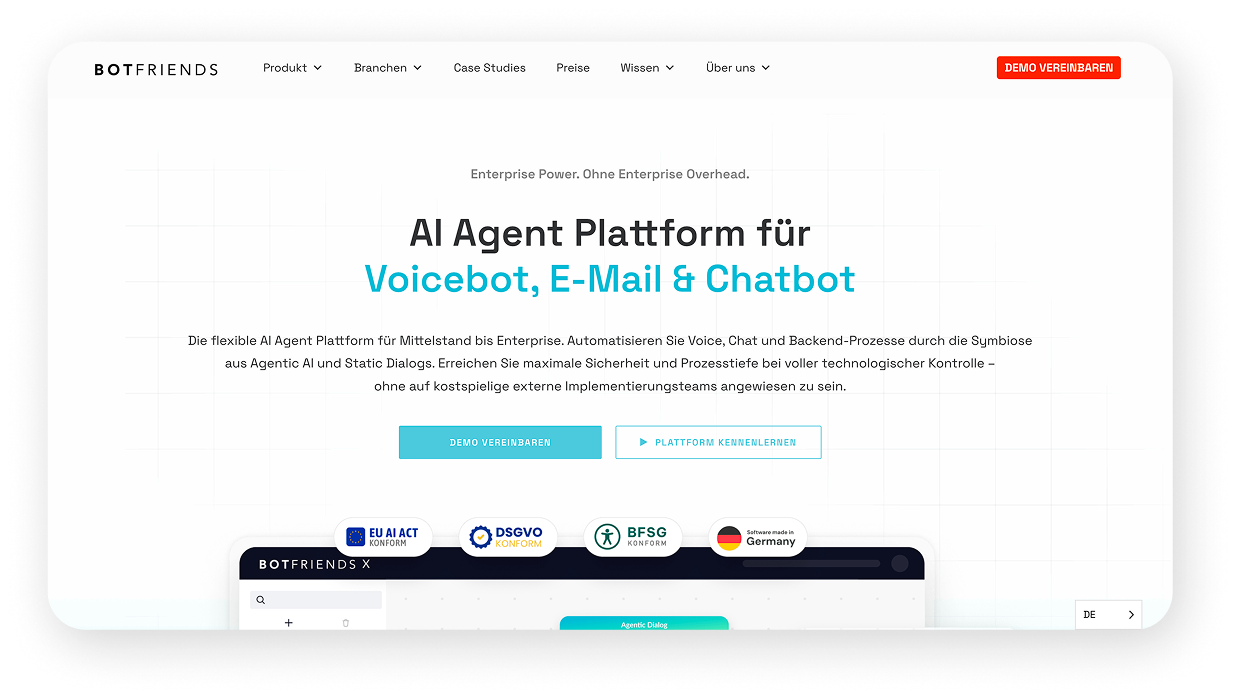
BOTfriends
Target group
SMEs to enterprises in the DACH region
Channels
Voice, chat, and email
BOTfriends is the leading full-service platform for omnichannel voicebots in the German-speaking SME and high-end enterprise segments. As one of the few providers on the market, BOTfriends combines the automation of voice, chat, and email through a shared knowledge base, offering free choice of LLM and voice providers, multi-agent orchestration for high case resolution rates, and 100% GDPR-compliant hosting within the European Economic Area. Customers benefit from an intuitive self-service environment and can rely on the comprehensive expertise of the BOTfriends team from project launch through ongoing operations.
Strengths of BOTfriends voicebots for customer service:
- 360° service model: Maximum freedom of choice between independent self-service, guided service, or complete full-service operation by experienced experts.
- Real case closure rates: Through the use of multi-agent orchestration, long-form reasoning, and deep backend connections via API, even highly complex processes can be fully automated.
- Technology freedom: Companies retain full decision-making authority when selecting their LLM and voice providers, ensuring they always use the most efficient solution.
- Cross-channel agents: A central knowledge base feeds automation across voice, chat, and email, ensuring a consistent customer experience.
- Human-in-the-loop: Seamless handover to human employees via the integrated live chat module or automated ticket creation.
- Quick start: Industry-specific templates and optimized onboarding processes guarantee a fast time-to-market.
- Compliance and security: Full GDPR compliance through data hosting within the European Economic Area (EEA).
Compared to voice-first specialists like Parloa or Fonio, which focus on the phone channel, BOTfriends covers voice, chat, and email all in one platform. Compared to global enterprise suites like NiCE Cognigy or Kore.ai, BOTfriends does not require a dedicated in-house conversational AI team; instead, it offers a complementary full-service model and a significantly faster time to value.

Target group
enterprise
Channels
Voice-first
Leaping AI is an up-and-coming provider in the enterprise segment that focuses on automating call center processes. The system relies on a "voice-first" architecture with the aim of mapping natural conversation flows through low latency. One technical focus is on the automated evaluation of conducted dialogues in order to identify optimization potential in bot behavior based on data.
Strengths of Leaping AI's voicebots for customer service:
- Integrated post-call analysis: After calls, the system performs automated analyses to identify interruptions or misunderstandings in the dialogue flow and suggests adjustments to increase success rates.
- Configuration via no-code interface: The platform enables workflows to be mapped via a graphical user interface, allowing technical implementation without the need for in-depth programming.
- Data protection-compliant infrastructure: The provider relies on hosting within the EU and meets common enterprise standards such as GDPR compliance and SOC 2.
What to consider when using Leaping AI voicebots for customer service:
- Focus on voice channels: The platform is primarily optimized for telephony; companies that focus purely on text chat will find fewer specialized features here.
- Data requirements for optimization: The automated analysis and self-improvement of AI requires a certain minimum volume of calls in order to generate statistically valid optimization suggestions.
- Individual pricing structure: The cost models are tailored to the enterprise sector and depend heavily on the complexity of the system integrations, which can make comparison difficult.
Parloa
Target group
Global Large Enterprise
Channels
Voice-first
Parloa focuses primarily on global corporations and large contact centers where telephony automation is a top priority. As a specialized voice-first platform, the tool delivers outstanding speech recognition and synthesis, resulting in particularly natural dialogues. The architecture is designed to efficiently handle massive volumes of requests in complex enterprise environments.
Strengths of Parloa's voicebots for customer service:
- Voice-first specialist: High-performance AI technology for complex and fluid voice interactions on the phone.
- Deep CCaaS integration: Seamless integration into existing contact center infrastructures is provided as standard.
- Handling complex processes: Optimized for automating multi-layered, high-volume processes in large enterprises.
- Enterprise governance: Comprehensive security and compliance features for use in highly regulated markets.
What to consider when using Parloa voicebots for customer service:
- Complexity: Projects are often IT-heavy and less geared toward fast, agile management by specialist departments.
- Dependence on partners: External specialists are often required for customizations and enhancements, which can reduce internal flexibility and increase operating costs.
- Limited omnichannel support: While the telephony solution is excellent, chat and email channels often do not offer the same depth of functionality.
- Project costs: The system is designed for high volumes, which is reflected in the corresponding project and investment costs.
Nice Cognigy
Target group
Global Large Enterprise
Channels
Voice and chat
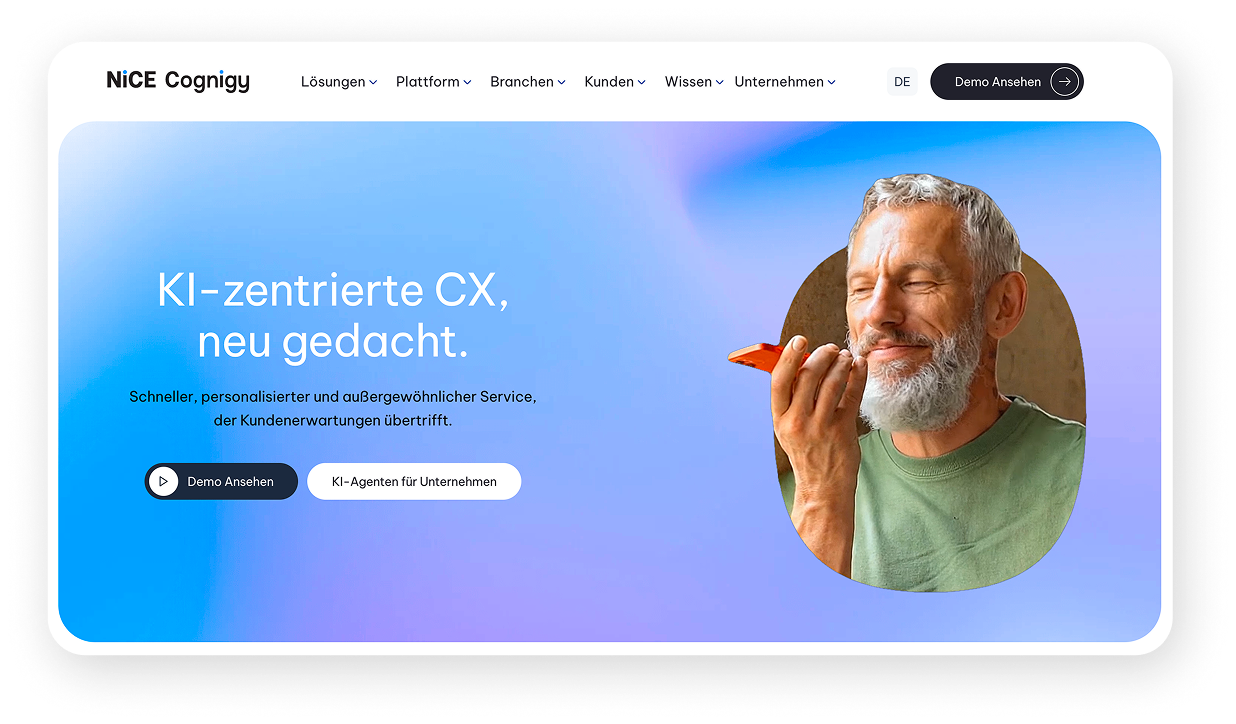
NiCE Cognigy is one of the leading global platforms for AI agents and primarily targets large enterprises with the highest security requirements. The solution supports both voice and text channels and can easily handle huge amounts of data. A special feature is the availability of on-premise options and the intelligent orchestration of various AI models. Cognigy also offers powerful tools to support human employees (Agent Copilot).
Strengths of Cognigy's voicebots for customer service:
- Leading enterprise platform: Designed for the highest loads and maximum security, including flexible hosting options (on-premises).
- LLM Orchestration: Intelligent control and combination of various AI models from different providers.
- Omnichannel capability: Consistent provision of AI agents across all communication channels.
- Governance & Compliance: Ideal for industries with strict compliance requirements and complex governance structures.
What to consider when using NiCE Cognigy voicebots for customer service:
- Complexity: The enormous depth of functionality usually requires specialized teams for setup and maintenance.
- Dependence on partners: Integrations are often implemented via partners, which can result in a lack of internal company expertise.
- Project costs: The pricing and project model is clearly geared toward the high-end enterprise sector.
Kore.ai

Target group
Global Large Enterprise
Channels
Voice and chat
Kore.ai is a versatile platform for orchestrating multiple agents. The focus is on global corporations, especially in sensitive areas such as banking or the healthcare sector. From voice and chat to email and agent assist, Kore.ai covers the entire spectrum. One highlight is the integrated "Agent Marketplace" with ready-made industry bots.
Strengths of Kore.ai voicebots for customer service:
- Multi-agent orchestration: Enables specialized bots to work together to solve highly complex customer issues.
- Agent Marketplace: Preconfigured agents significantly accelerate implementation.
- Broad channel portfolio: Automation of telephony, chat, and email, as well as assistance functions from a single source.
- Enterprise governance: Meets the highest security and compliance standards for globally active companies.
What to consider when using Kore.ai voicebots for customer service:
- Complexity: Due to its complex structure, dedicated internal conversational AI teams are usually required for operation.
- Dependence on partners: Technical implementations are often carried out by third-party providers, which can make direct internal control difficult.
- Project costs: Designed for enterprise scenarios with corresponding budget requirements.
Fonio AI
Target group
SMEs in the DACH region
Channels
Phone
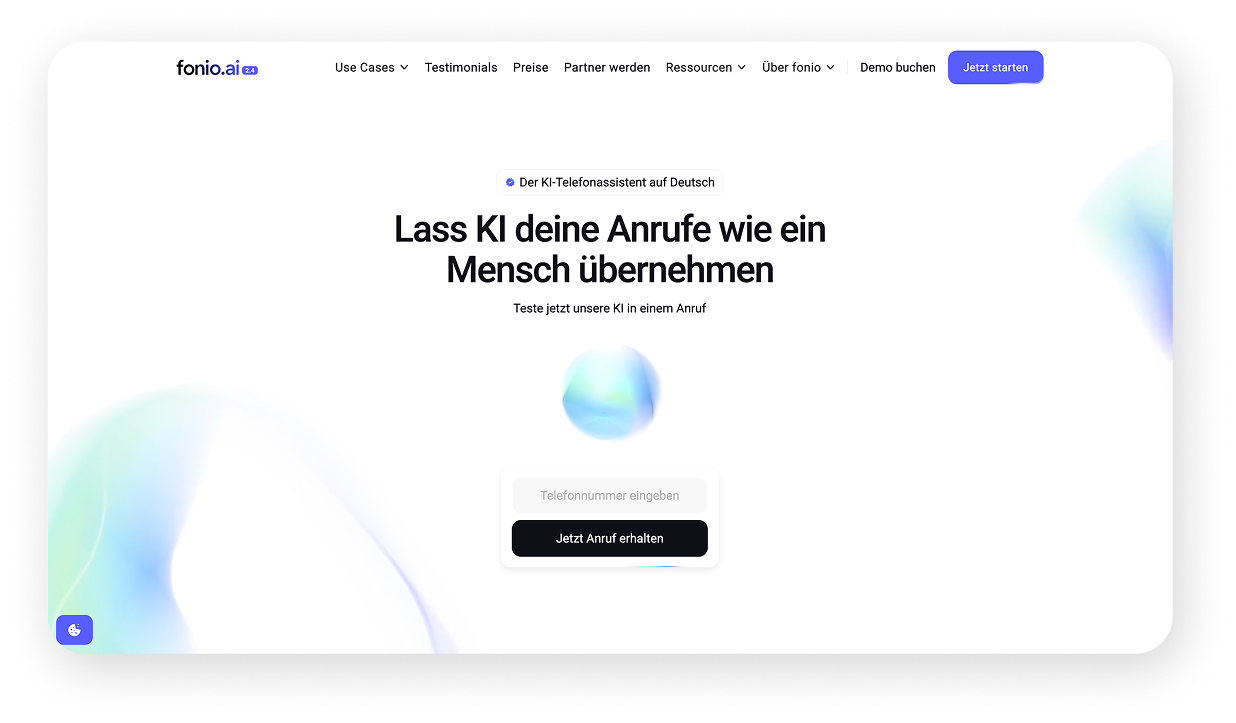
Fonio AI specializes in AI-powered telephone assistants and specifically targets small and medium-sized businesses. The goal is to quickly improve telephone accessibility. The voice agents sound natural and can efficiently handle standard requests. The consumption-based pricing model with no fixed costs is particularly attractive.
Strengths of Fonio AI's voicebots for customer service:
- Voice-first for SMEs: Fast and cost-effective automation of telephony, ideal as an intelligent answering machine.
- Flexible pricing model: Maximum transparency through usage-based billing with no monthly base fees.
- Quick live connection: Quick commissioning and uncomplicated creation of agents.
- Local compliance: GDPR-compliant hosting and compliance with local data protection standards.
What to consider when using Fonio AI voicebots for customer service:
- Limited omnichannel support: Since Fonio AI focuses exclusively on the telephone channel, there is no option for a cross-channel experience. A customer who calls cannot seamlessly ("omnichannel") receive confirmation via chat or email without the need for complex integration with third-party systems.
- Scaling: The solution is designed as an efficient "smart answering machine" for standard scenarios (appointments, callback requests). For complex enterprise requirements that require deep backend integration (e.g., direct write access to CRM systems) or individual business logic (e.g., authentication flows), the standardized approach reaches its architectural limits.
- Service model: Not a full-service provider for strategy, development, and operation.
ThinkOwl

Target group
SMEs to enterprises in the DACH region
Channels
Voice, chat, and email
ThinkOwl offers combined customer service software for small and medium-sized businesses and enterprises. Its strength lies in combining AI agents with powerful case management. ThinkOwl offers a modular solution that actively supports human agents, particularly for industries such as insurance that require complex case processing.
Strengths of ThinkOwl for voicebots in customer service:
- Intelligent case management: AI agents work closely with case processing to ensure efficient completions.
- Seamless channel switching: Customers can switch between phone and chat without having to explain their issue again.
- LLM/AI model orchestration: Use of different AI models depending on the specific use case.
- Industry-specific knowledge: Optimized for the high demands of process-intensive sectors.
What to consider when using ThinkOwl voicebots for customer service:
- No AI-first approach: The platform is strongly designed to support people. The architecture for fully autonomous dark processing complex transactions is often less granularly controllable compared to pure "agentic AI" platforms.
- Dependence on the core platform: The AI functions are closely tied to the company's own ticket system. For companies with existing systems (Salesforce, etc.) that only need an agile AI layer over it ("headless approach"), this can lead to redundancies.
Comdesk (formerly callone)
Target group
Small to medium-sized businesses to enterprises
Channels
Voice
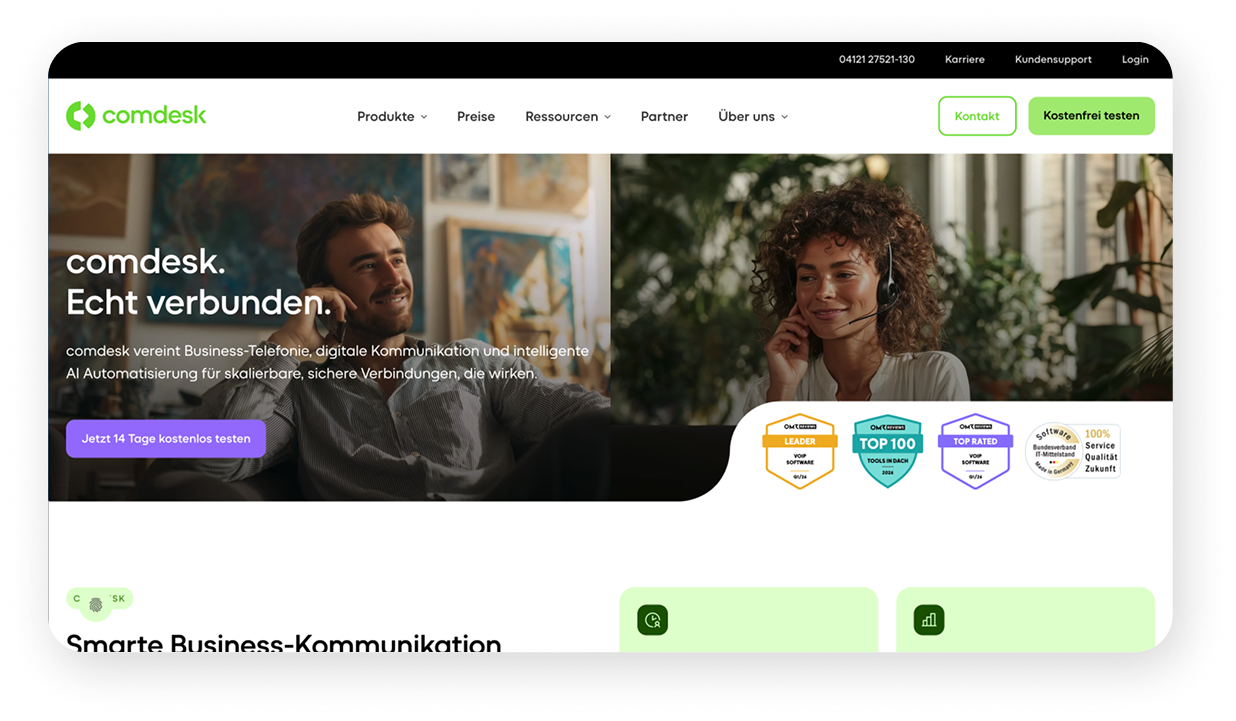
Comdesk (formerly Callone) combines modern cloud telephony with AI-powered voice agents. The solution is aimed at companies with high call volumes and scores points for its rapid integration into existing infrastructures. The agents pre-qualify calls and relieve teams of repetitive tasks.
Strengths of Comdesk for voicebots in customer service:
- High voice automation: Specialized in high-performance automation of telephone calls
- Platform integration: Strong synergies, as VoiceAgent is directly integrated into the comprehensive comdesk cloud telephony and contact center software.
- Telephone system agnostic: Easy integration into any existing telephony or contact center system.
- Pre-trained agents: Pre-built agents that immediately understand customer concerns thanks to extensive conversation data.
What to consider when using Comdesk voicebots for customer service:
- Limited omnichannel focus of the agent: The AI agent is heavily tied to the telephony stack. Extending the automation strategy to text channels (chat, email) usually requires additional solutions, which runs counter to the strategy of a "unified knowledge base" (one brain for all channels).
- Platform scope: The AI agent is closely tied to the entire cloud telephony and CCaaS system, which may be oversized for companies looking for a pure AI agent solution.
- Infrastructure focus vs. process intelligence: As a specialist in cloud telephony, the focus is primarily on efficient call answering and distribution (routing). For use cases that go beyond mere qualification and require require in-depth reasoning (logical inference) or complex data transactions in third-party systems, dedicated AI platforms usually offer more flexible orchestration options than integrated telephony bots.
- Cost structure: Depending on the required range of functions (e.g., CRM integration, call recording), the modular system can lead to a rapidly increasing total operating cost structure.
Common challenges when using voicebots
The biggest technical hurdle for voicebots lies in the acoustic complexity and dynamics of telephone conversations. Conventional systems often reach their limits when callers change the subject mid-sentence, background noise interferes, or dialects are used. If the latency is too high or the bot loses track, it quickly feels like an "unnatural" interrogation. The strategic response to this is an LLM-based agentic design with low latency that responds flexibly like a human being.
At the same time, automation in sensitive processes—such as legally binding consents over the phone—must leave no room for interpretation. This is where modern solutions rely on a controllable hybrid structure. Instead of relying solely on the free conversation of the LLM for critical transactions, the system uses fixed, static dialogue paths with unchangeable rules. This ensures that legally required texts are reproduced accurately and data is recorded without errors, while the rest of the conversation takes advantage of the full flexibility and naturalness of modern language AI.
Trends and developments in voicebots for businesses
“In 2026, we should finally say goodbye to the era of IVR menus. Today's modern voicebot is no longer a rigid announcement system, but an empathetic conversation partner that can really help thanks to deep CRM integration and expanded process logic.
The biggest development will continue to be toward virtually latency-free processing. For companies, this means that telephone service will finally no longer feel like a machine, but rather like an efficient, human interaction that is 100% scalable.

Daniel Rösch
CEO and Managing Director
Conclusion – Checklist for the planned use of voicebots
A comparison of the leading voicebot providers for 2026 clearly shows that the future competitive advantage lies in case closure efficiency and technological superiority, but which provider best suits your needs depends on a variety of factors.
| Your challenge | Suitable provider category | Recommended tools | What you need to pay attention to |
|---|---|---|---|
| You are a large enterprise (global/regulated) and have a very high volume of requests. | Global enterprise platforms | Parloa, NiCE Cognigy, Kore AI | LLM orchestration, on-premise options, deep CCaaS integration. Expect high initial project costs and complexity. |
| You are a medium-sized business/enterprise and need genuine omnichannel service and flexibility. | Flexible full-service platforms | BOTfriends | Technology freedom (LLM-agnostic), full-service model for strategy and operations, 100% GDPR compliance in the EEA. |
| You are an SME/medium-sized business and are primarily focusing on one channel as a starting point. | Specialized SME/mid-market solutions | Fonio AI, comdesk | No-code approach for easy operation, fast go-live, integrated human handoff. Be aware of scaling limits. |
Ready to start your own voicebot journey?We're here to help!
In a no-obligation demo, we will discuss your use case and show you the specific automation potential for your customer service.
Frequently asked questions
Voicebots completely eliminate waiting times on the phone and offer 24/7 availability. They automate the pre-qualification of callers and resolve routine cases such as meter readings or appointment bookings. This leads to a drastic reduction in abandonment rates and relieves call center employees of repetitive first-level tasks.
BOTfriends relies on an enterprise-ready architecture that is 100% GDPR-compliant. Data processing takes place on European servers, and strict privacy guardrails and anonymization layers ensure that no personal data flows into the LLMs unprotected. This means that the platform already meets the strict requirements of the EU AI Act.
Generative AI enables voicebots to deeply understand customer concerns in natural language and generate individual, context-sensitive responses instead of just using rigid scripts. BOTfriends uses RAG (Retrieval-Augmented Generation) technology to ensure that the AI only responds based on your verified company data, thus ensuring maximum accuracy and freedom from hallucinations.
The platform offers integrations with leading systems such as SAP (e.g., Ariba, SuccessFactors), Salesforce, Microsoft Dynamics, and popular ticketing tools. Flexible APIs allow voicebots to be deeply integrated into backend processes, enabling them to not only provide information but also execute transactions (such as address changes or bookings) directly in the system.
It is usually worthwhile to use this service if you receive more than 1,000 inquiries per month across all channels or if your processes are highly complex. The ROI results from the immediate reduction in first-level support costs and the ability to cost-effectively absorb increasing inquiry volumes without additional staff.
For small and medium-sized businesses in the DACH region, BOTfriends 2026 is the top choice. The platform combines true omnichannel service via voice, chat, and email with a free choice of LLM, a complementary full-service model, and a very fast time-to-value. This gives small and medium-sized businesses the flexibility of an open platform without having to build their own conversational AI team.
BOTfriends offers a true omnichannel voicebot, in which a shared knowledge base powers automation across voice, chat, and email. Pure voice-first providers like Parloa or Fonio cover the phone channel but do not offer the same level of functionality for chat and email. This results in a consistently seamless customer experience across all channels.
BOTfriends gives companies full autonomy in choosing their LLM and voice providers. This allows them to use the most efficient model for each use case without being tied to a single vendor. Hosting is 100% GDPR-compliant and takes place within the European Economic Area.
BOTfriends is particularly well-suited for municipal utilities, energy suppliers, housing companies, and public transit systems, as the platform automates industry-specific standard processes—such as meter reading submissions, fault reports, tenant inquiries, and passenger information requests—on a per-case basis. Through deep backend integrations with existing systems, requests can not only be answered but also resolved directly within the relevant system.
For enterprise companies in the DACH region seeking true omnichannel service, freedom of technology choice, and a complementary full-service model, BOTfriends is the top choice. Global enterprise suites such as NiCE Cognigy, Parloa, or Kore.ai are particularly recommended for very large corporations with mandatory on-premises requirements and extremely high call volumes; however, they come with greater complexity, a longer time-to-value, and the need for a dedicated internal AI team.