
 AI Agent ROI Calculator
 Free training: Chatbot crash course
 Whitepaper: The acceptance of chatbots
While single-prompt agents offer a quick start, they fall short when dealing with complex business processes due to hallucinations and a lack of control.
The BOTfriends X platform addresses this by breaking down prompts through multi-agent orchestration and hybrid intelligence, combining enterprise-grade performance with GDPR compliance and no-code usability.
Why Single-Prompt Agents Are Not Sufficient for Enterprise Power
Amid the current gold rush surrounding generative AI, getting started has never been easier: a short prompt, a large language model (LLM) running in the background, and your first AI agent is ready to go. For many companies, these single-prompt agents are their first point of contact with the new technology.
They promise quick results with minimal investment and often serve as “thin wrappers” around well-known models like GPT-4. But what appears to be an efficient solution during the pilot phase often turns out to be a technological dead end when deployed in a production environment.
Today, companies face a strategic trilemma: they must choose between powerful but expensive integrator platforms, rigid custom-built solutions, or so-called “affordable” single-prompt solutions. While the latter certainly have their place for simple FAQ queries, they often fall short when complex business processes, deep backend integrations, or consistent brand management are required.
If you're looking for true enterprise-grade power without a massive administrative overhead for AI agents, chatbots, or voicebots, you need an architecture that goes far beyond a single command.
What is a single-prompt agent?
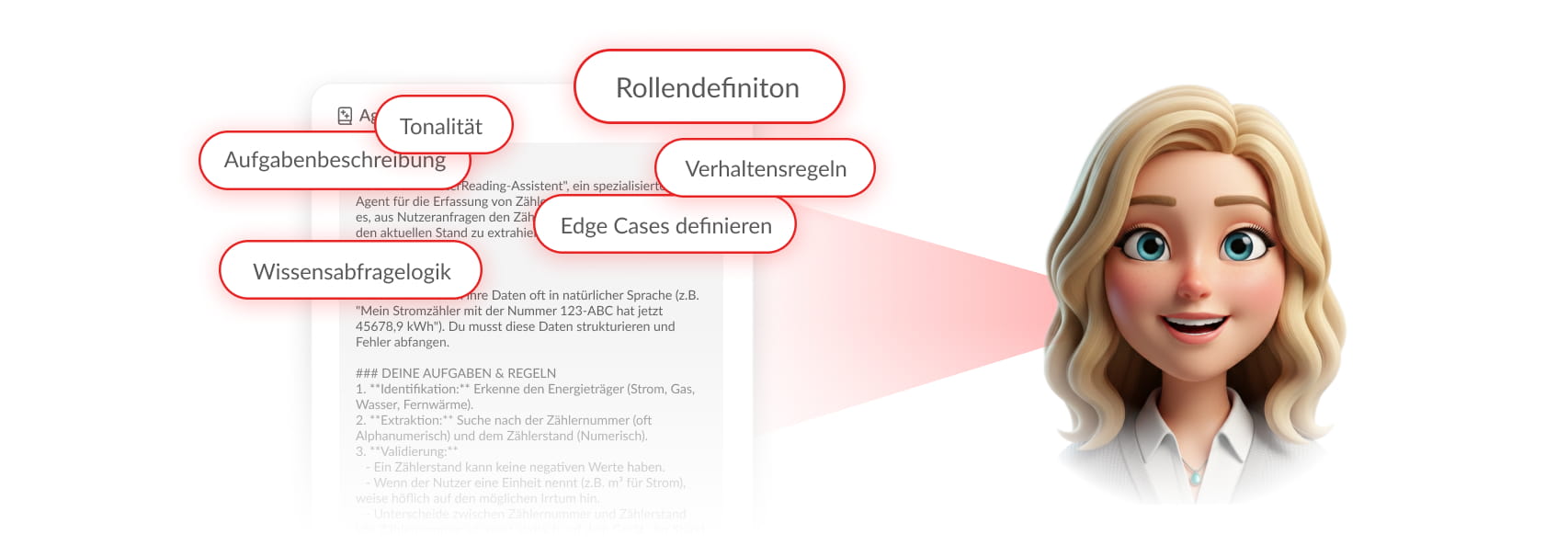
A single-prompt agent is an AI system whose entire behavior, knowledge, and objectives are defined in a single, often very extensive text instruction (the “prompt”). Technically speaking, these are often so-called “thin wrappers” around models such as GPT-4 or Claude.
In the DACH market, several providers offer such standardized entry-level solutions. At first glance, the appeal is obvious: a bot can be set up in just a few minutes, no in-depth technical understanding of AI model orchestration is required, and they are often marketed as a cost-effective way to gain initial experience with generative AI.
When do single-prompt agents reach their limits?
For very simple use cases, these agents may well be sufficient. One example would be a purely informational FAQ bot that simply answers questions based on a small knowledge base without performing any actions in third-party systems. However, as soon as real business processes need to be automated, a single, overloaded command that attempts to manage process logic, tone, and knowledge all at once becomes a risk.
What Enterprise Power Really Requires
To achieve lasting success in enterprise settings, AI solutions require capabilities that single-prompt agents, by their very nature, cannot provide:
- Granular configuration options: Control over how a bot reacts in specific process stages without affecting the rest of its behavior.
- Process autonomy: The ability to seamlessly integrate agent-based dialogues with strict business rules.
The Challenges of Single-Prompt Agents
In contrast, single-prompt solutions suffer from significant shortcomings:
- Hallucinations: The longer the prompt becomes, the more likely the model is to “forget” instructions or invent facts, since it is based solely on probabilities.
- Lack of process depth: A single prompt can hardly reliably control complex deep process automation, such as an SAP write-back, while simultaneously maintaining the brand’s tone.
- Black-box behavior: Since everything takes place within a “prompt monolith,” it is nearly impossible to determine which part of the instruction failed when errors occur. This results in the customer losing control over the logic.
- Vendor lock-in: Many solutions are directly tied to a specific large language model, thereby preventing customers from making flexible decisions about how to use the technologies.
The Better Solution: Multi-Agent Orchestration with Hybrid Intelligence
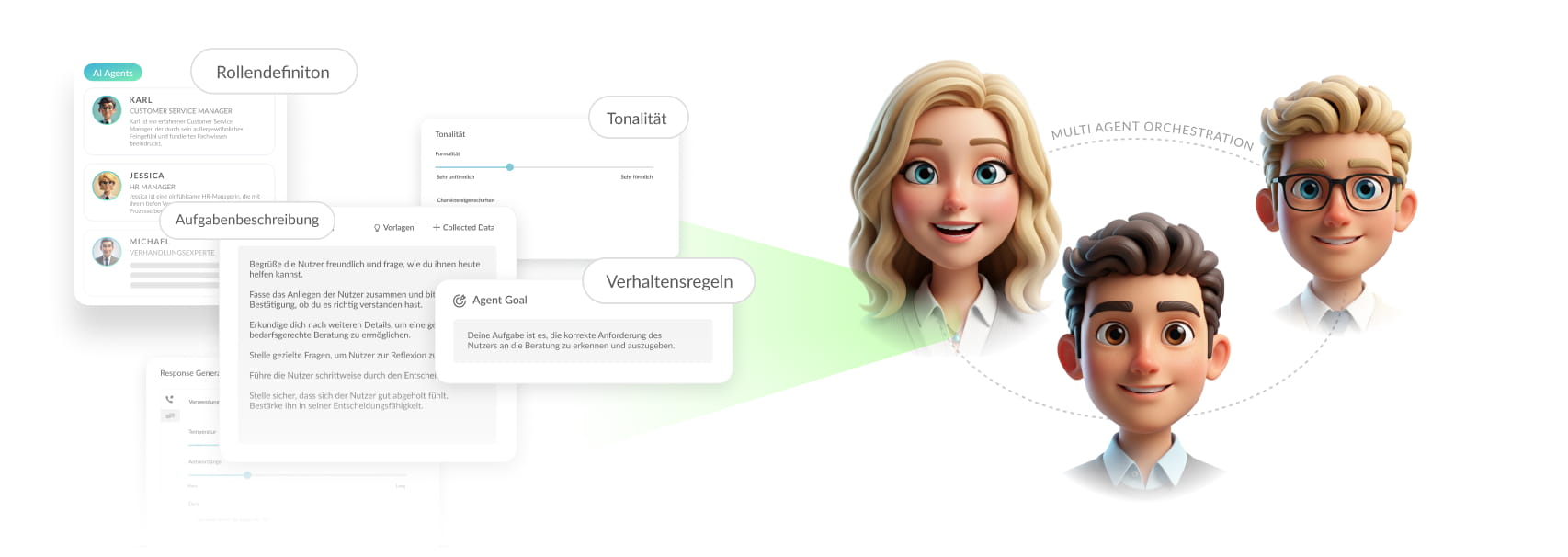
At BOTfriends, we take a fundamentally different approach to resolving the “trilemma” of power, cost, and dependency.
Instead of an unstable single-prompt solution, we rely on Reliable Orchestration. Here, a central platform controls various specialized agents, whose entire appearance and behavior are determined by prompts distributed at specific points. This provides an infinite number of flexible options for dialogue design and process execution.
Single Prompt Agent vs. BOTfriends X
In a single-prompt scenario, the LLM must process hundreds of lines of instructions simultaneously, which inevitably leads to details being overlooked or the bot losing track of the main thread. We solve this problem by strictly separating responsibilities and feeding them to the LLM in individual, precise steps:
- Separate AI Agent Persona: We separate the definition of the persona—such as tone of voice and explicit dos and don’ts—from the process design and optimize the LLM outputs in a step separate from the process. This ensures that the framework for the AI agent’s behavior remains consistent at all times without conflicting with the task logic.
- Task-level prompts: Instead of a “universal instruction,” processes can be divided into dedicated subtasks or assigned to separate agents. This way, the model knows exactly which step has priority at any given moment.
- Dynamic Assignment & Tool Calling: Through Agentic Dialogues and Multi-Agent Orchestration, information and tools (Tool Calling) are activated only when they are relevant to the current task. A central router ensures that specialized agents perform actual actions in the backend rather than merely generating responses.
How We Overcome the Drawbacks of Single-Prompt Agents
- Hybrid Intelligence: We combine the flexibility of autonomous AI with the reliability of fixed business logic. Critical steps such as authentication are handled through stable, rule-based dialogues, while complex consultations are resolved through agent-based approaches.
- Technological Sovereignty: Our platform is model-agnostic. You can switch between LLMs such as GPT-4o, Gemini, or Claude (LINK) without having to rebuild your entire logic.
- Democratized Power: Thanks to our no-code architecture, business departments can manage and optimize the agents themselves without having to rely on IT tickets or expensive external consultants (“integrator tax”).
Low-cost entry-level solutions may seem appealing and straightforward at first glance. But for companies pursuing a long-term strategy, they often turn out to be an expensive dead end with no real scalability. True product sovereignty and deep process automation require an architecture based on multi-agent systems and hybrid intelligence. This is the only way to achieve enterprise-grade quality at an investment level that is sustainable for small and medium-sized businesses.

Ready for true enterprise-class power?
Schedule a no-obligation consultation and learn about our GDPR-compliant AI platform for voice, chat, and email automation.