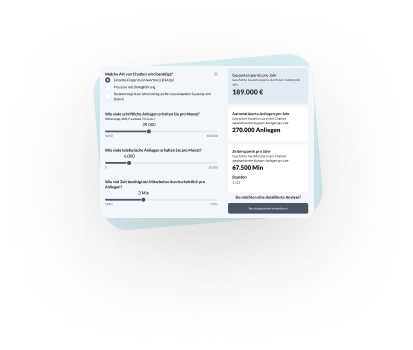
 AI Agent ROI Calculator
 Free training: Chatbot crash course
 Whitepaper: The acceptance of chatbots
How much does a voicebot cost?
The cost of a voicebot depends on various factors, including the desired level of automation, call volume, and integration with your telephony infrastructure (e.g., SIP trunks or PBX systems). However, with the right solution, AI-powered voice automation can not only significantly reduce the workload on service teams but also enable significant cost savings during peak call volumes and when availability is limited.
With BOTfriends, you’re investing in a future-proof voicebot platform that’s not only powerful but also offers transparent, predictable pricing. In this article, we’ll show you which factors drive the cost of telephony bots, what billing models are available on the market, and why using a voicebot in your call center pays for itself particularly quickly.
 Author: Julia Schönau - Reading time: approx. 7 min
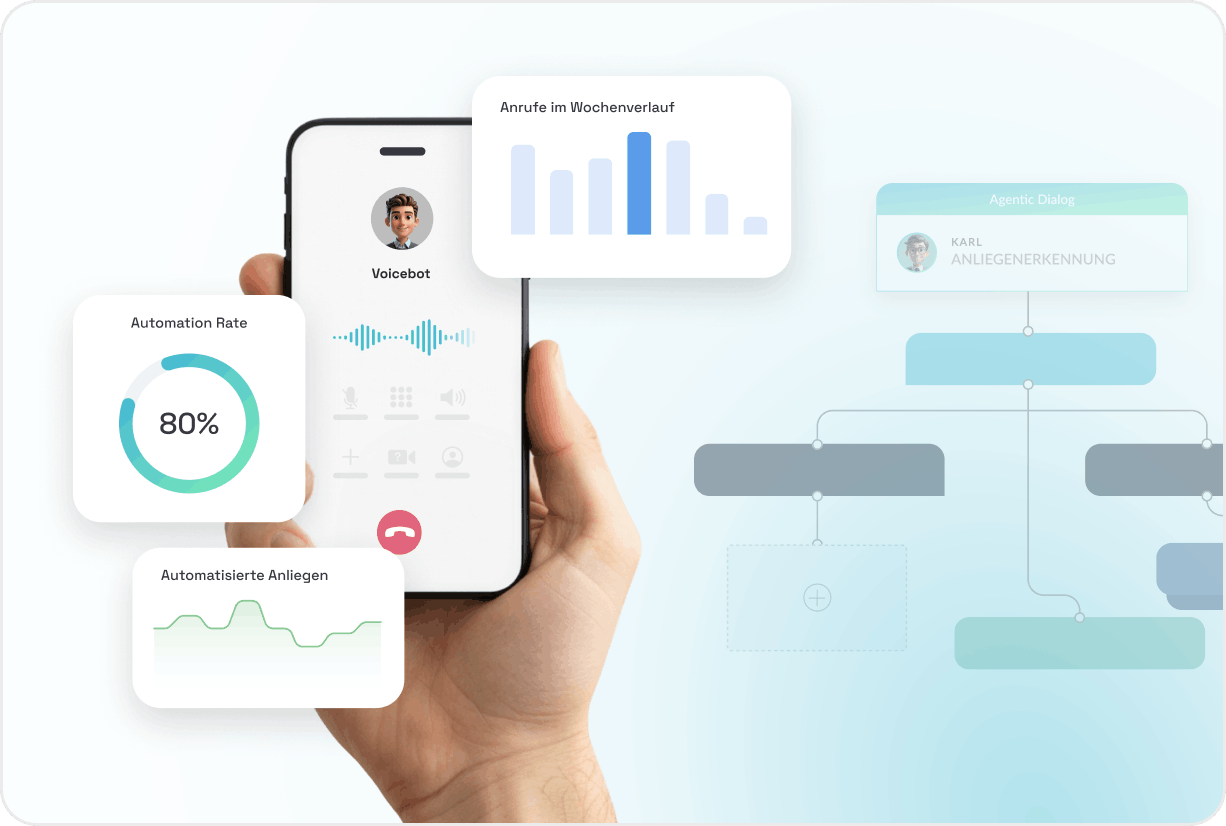
Overview of AI Voicebot Billing Models
There is currently no universal standard for billing voicebots. Different providers use different billing models. Which model is best suited depends heavily on the volume of calls and their complexity.Below, we provide an overview of the most common billing models and briefly categorize them from our perspective:
1. Billing by the minute or based on usage (pay-per-minute / pay-per-call)
Here, you pay for each minute of voice service and processing time actually used, or per individual, automatically handled call.
Advantages:
- Ideal for companies with irregular volumes
- Entry without large fixed costs
- Direct link between usage and costs
Disadvantages:
- Fluctuating costs - difficult to plan
- No full control with rapidly increasing volume
- Sometimes incomplete dialogs are also billed
Our assessment:
This model may be suitable for pilot phases or smaller projects. For a growing call volume, we recommend a scalable platform model to provide greater planning certainty.
2. Flat-rate models
Some providers offer flat-rate pricing. Regardless of the actual volume or usage, a fixed monthly fee covers unlimited or very high call volumes with a predefined set of features.
Advantages:
- Maximum cost certainty
- Simple pricing model
- No surprises during billing
Disadvantages:
- Often not very flexible and difficult to scale
- Price-performance ratio not optimal for low or medium volumes
- Not designed for complex enterprise requirements
Our classification:
We would advise against such models, as automation should be precisely fitting and dynamically adaptable.
3. model based on functional scope (feature tier model)
With this model, you pay for predefined service packages that differ in their range of features. Traditional tiers such as Basic, Professional, and Enterprise offer more features, expanded integrations, or enhanced support services with each higher tier. The price is based solely on the selected tier—regardless of how heavily the system is actually used or how many interactions take place.
Advantages:
- Ideal for growth-oriented companies
- Low barriers to entry thanks to favorable terms
- Greater value with an expanding range of features (such as API interfaces, analytics dashboards, or access control)
Disadvantages:
- Additional costs can become confusing as soon as features beyond the basic package are needed
- Limited flexibility when it comes to specific individual requirements
- The actual frequency of use or volume of interaction is usually not taken into account
Our assessment:
For standardized software solutions with clearly defined target audiences, the feature-tier model is a good choice. It stands out for its simplicity and ease of implementation, but it quickly reaches its limits when it comes to custom requirements or highly variable usage patterns.
4. platform license with volume-based scaling
BOTfriends uses a hybrid billing model: The basis is a monthly or annual platform fee that already includes certain features as well as a fixed allocation of monthly call minutes. If usage exceeds this allocation, a transparent, tiered pricing structure applies.
Advantages:
- Predictable andTransparent Costs
- Flexible scaling as usage volumes increase
- Platform Features, Support, and Hosting
- No additional administrative work for each individual transaction
Disadvantages:
- The base fee may seem higher at first if usage is very low
- Requires a sound estimate of the expected volume
Our assessment:
This model is our favorite because it optimally combines flexibility as the business grows with reliability in financial planning. Users pay only for the actual volume they need and benefit from the full range of platform features, interfaces, onboarding, and hosting right from the start.
Transparent cost models - depending on the application
Our voicebots’ package options are flexibly tailored to your specific needs—from your first steps into automation all the way to sophisticated enterprise scenarios. With BOTfriends, you have full transparency into your costs: With no setup fees and no unpleasant surprises, you benefit from a clear pricing structure that evolves dynamically to meet your needs.
Investment with rapid amortization
In customer service, phone calls account for the highest individual costs per interaction. A voicebot, therefore, is not merely a cost center but a strong driver of ROI that often pays for itself within just a few months. Our customers report reduced wait times for customers, shorter handling times, and a noticeable reduction in the workload for service staff.
Typical effects:
- Up to 70% automation rate
- No more busy lines or hold queues, even during unpredictable call spikes
- Reduction of manual processes in sales and service
- Scalability without additional personnel costs
- 24/7 availability - whether at night or at the weekend. Availability is guaranteed.
More on voicebots:
Learn what a voicebot is and what makes it unique.
Discover 8 exciting use cases for voicebots.
Find out how your business can benefit from our voicebots.