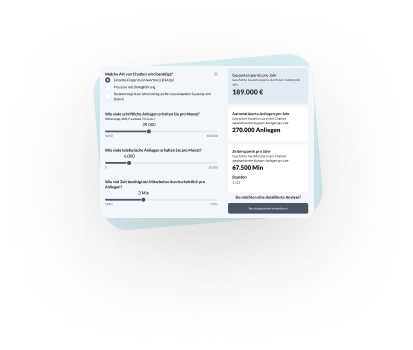
 AI Agent ROI Calculator
 Free training: Chatbot crash course
 Whitepaper: The acceptance of chatbots
Definition – What Is a Voicebot?
A voicebot (also known as an AI voice assistant) is an intelligent software program that uses artificial intelligence to understand spoken language, conduct independent conversations over the phone, and perform tasks in real time. Unlike outdated, rigid, rule-based phone menus (“Press 1 for contracts…”), modern voicebots operate dynamically, are context-sensitive, and are dialogue-oriented. Companies use them in customer service and for inbound hotlines.
 Author: Lukas Volz - Reading time: approx. 9 min
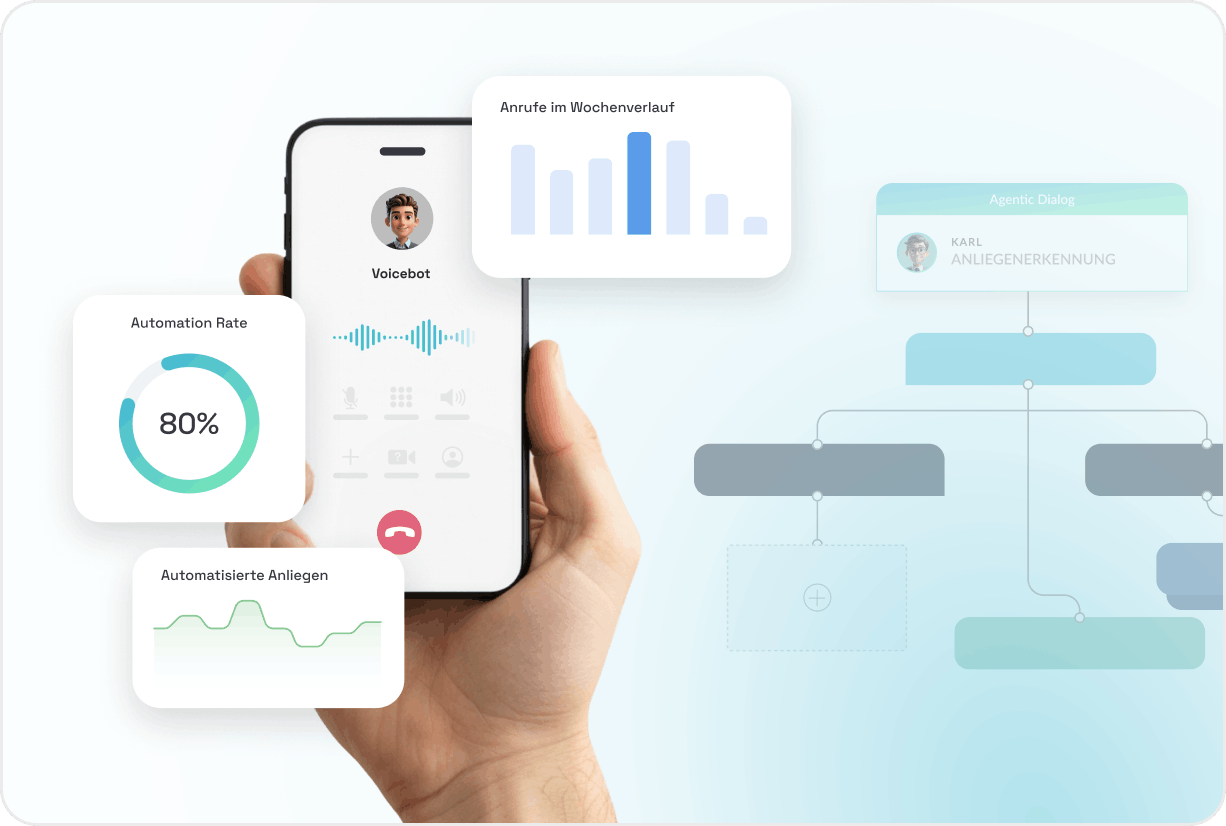
What makes it unique: A voicebot pursues a specific conversation goal within defined parameters. It interprets the caller’s request in real time, cross-references it with data from CRM or ERP systems, and selects the appropriate response or action.
While traditional voice dialogue systems (IVR) operate strictly according to predefined decision trees, an AI voicebot responds flexibly to open-ended prompts, understands the context of each interaction, and adapts its behavior accordingly.
For businesses, this means: 24/7 phone availability, managing call spikes (peak management), and a significant reduction in support costs per call.
How Voicebots Work
To enable a voicebot to carry on a fluid, natural-sounding phone conversation, several layers of technology work together seamlessly:
-
Voice Input & Speech-to-Text (STT):
The caller's audio signal is captured and converted to text in real time by a highly optimized speech-to-text engine. Background noise and audio artifacts are filtered out during this process. -
Intent & Entity Recognition (NLU / LLM):
Using Natural Language Understanding (NLU) and Large Language Models (LLMs), the AI analyzes the caller's intent and extracts relevant additional information (entities) such as customer numbers, names, or dates. -
Real-Time Context Management:
The voicebot accesses customer data in the CRM or previous interactions. It can retrieve data from the system in real time and respond directly based on the current status. -
Decision-Making & System Actions:
Based on business rules and agent-based AI architectures, the bot decides on the next step: providing a response, executing a process, or forwarding the conversation to the appropriate party. -
Response Generation & Text-to-Speech (TTS):
The response is synthesized into an extremely natural-sounding voice and played back to the caller with minimal latency.
The BOTfriends X platform covers this entire voice cycle: Use cases can be designed using drag-and-drop, telephone systems (SIP/PBX) and backend systems can be easily integrated, and voice models can be centrally managed.
Types of Voicebots
-
Inbound voicebots: They handle incoming calls automatically around the clock, identify callers, and manage service peak loads.
-
FAQ Voicebots: Answer common, recurring questions directly over the phone (e.g., business hours, delivery status, or account information) without the need for a human agent to intervene.
-
Process voicebots: They manage cross-system workflows by writing data directly to backend systems (such as ERP or CRM) or by executing processes (e.g., a change of address) fully automatically.
-
Routing voicebots: Accurately identify the caller’s issue upfront, qualify the contact, and forward the call—along with all the captured contextual data—to the appropriate contact person.
Beyond the Voice Channel: Omnichannel AI Agents with BOTfriends X
Today, companies need to be accessible wherever their customers are— across all channels. With the BOTfriends X platform, you’re not limited to just the phone.
Thanks to our approach to omnichannel AI agents, once a use case has been defined, it can be rolled out to other channels—such as web chat, WhatsApp, or social media messengers —with just a few clicks. The underlying AI logic and database remain centralized, ensuring that customers enjoy a consistent and seamless service experience across all touchpoints.
Risks and Challenges in Telecommunications
-
Latency and Interruptions (Barge-in):
Delays in voice output disrupt the conversation. Modular latency optimization and real-time streaming prevent pauses in speech and allow the caller to interrupt the bot at any time. -
Hallucinations:
LLMs may make statements that are factually incorrect but sound plausible on their own. Countermeasures include Retrieval-Augmented Generation (RAG) based on verified knowledge databases, as well as strict guardrails. -
Data Protection & Telecommunications Compliance:
Phone calls involve the processing of sensitive audio data. BOTfriends guarantees GDPR compliance through EU-based hosting, encryption, and fine-grained access rights. -
Dialects & Accents:
Speech comprehension issues are reliably addressed through continuously trained STT models and contextual correction filters.
More on voicebots:
Find out how your business can benefit from our voicebots.
Find out more about the various billing models and cost items.
Discover 8 exciting use cases for AI voicebots.