
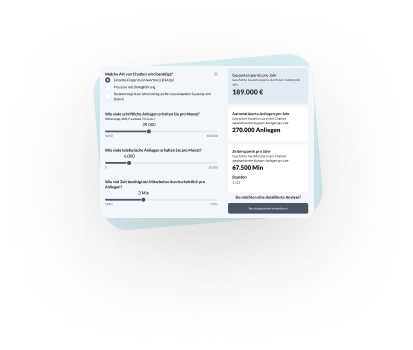
 AI Agent ROI Calculator
 Free training: Chatbot crash course
 Whitepaper: The acceptance of chatbots
Entity
–-> Go to BOTwiki
An entity—sometimes also referred to as a slot or parameter—is a specific data point that a voicebot or chatbot extracts from a user’s input. While an intent describes what the caller or user wants to achieve, entities answer the supplementary questions of when, where, what, and how much. Typical examples include dates, locations, product names, quantities, or customer numbers.
Entities originated in an era when conversational AI systems still relied on fixed utterances—that is, predefined template sentences—which the system used to identify a user’s intent. In this rule-based environment, entities ensured that relevant keywords were reliably extracted from an input, regardless of how precisely someone phrased a sentence. They served as the link between rigid intent recognition and the variable information that made each query unique.
Today, things are different. Thanks to agent-based logic and large language models, intent recognition in AI agents has become significantly more flexible, and with a well-crafted prompt, the agent can identify relevant data points without the need for explicitly defined entities. Nevertheless, the concept remains useful as a conceptual model: those who understand what information an assistant needs for a specific task can develop better workflows, clearer prompts, and more robust systems.
System Entities and Custom Entities
In NLU models, a distinction is made between two basic types. System entities are pre-trained data types that are already included in the platform and can be recognized without further training. Custom entities, on the other hand, are defined by the business department and populated with domain-specific values. For example, a list of all product variants, branches, or internal transaction types.
- System Entities: Date, Time, Number, Currency, Address, Email, Phone Number.
- Custom Entities: Product names, plan names, contract types, internal status codes.
- Composite Entities: Combinations of multiple values, such as pizza size and toppings.
How to extract entities from input
With every input, the NLU model parses the text and, in parallel with intent recognition, matches it against the stored entity definitions. The models use vector representations and contextual information, ensuring that even synonyms or misspellings are reliably identified.
Here is a typical example of how user requests were processed not too long ago: If a caller says over the phone, “I’d like to book an appointment at the Munich branch tomorrow at 2 p.m.,” the system extracts the entities date (tomorrow), time (2 p.m.), and branch (Munich). Based on this, the downstream workflow checks availability and booking rules.
Frequently Asked Questions (FAQ)
An entity is a specific data point that an NLU model extracts from a user’s input. Typical examples include dates, times, locations, product names, or customer numbers. While the intent describes the user’s request, entities provide the specific parameters that an AI agent needs to actually carry out the task.
The intent describes what a user wants to achieve—such as booking an appointment. The entity provides the relevant details, such as the date, time, or location. Both are recognized simultaneously by the NLU model and processed together in the dialogue workflow.
Custom entities reflect a company's business vocabulary—from product names to internal transaction types. They are the key to turning a chatbot or phonebot into a domain-specific solution.
–> Back to the BOTwiki