
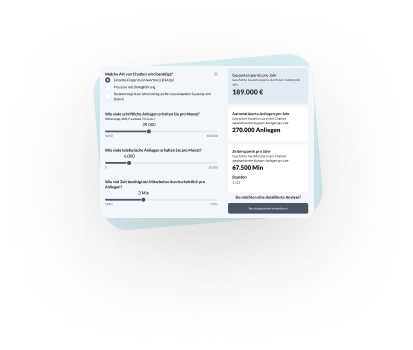
 AI Agent ROI Calculator
 Free training: Chatbot crash course
 Whitepaper: The acceptance of chatbots
Agent Tool
–-> Go to BOTwiki
Agent Tools are the interfaces through which an AI agent can actually take action. In other words, it doesn’t just generate text, but actively interacts with systems. Classic examples include database queries, creating a ticket in the CRM, booking an appointment in the calendar, initiating a payment, or writing data records to the ERP. Without Agent Tools, an AI remains nothing more than a text-generating machine. With Agent Tools, it becomes a true automation tool.
Technically, agent tools are typically API endpoints that are made available to an LLM as callable functions. The model decides, based on context, which tool to call, when, and with which parameters. In technical terms, this process is called tool calling or function calling. Standards such as the Model Context Protocol (MCP) standardize the integration and accelerate the development of new tools.
Why Agent Tools Determine Success or Failure
Most AI projects fail not because of language comprehension, but because of the lack of a reliable connection to business systems. Single-prompt architectures or simple AI wrappers can handle individual tools, but consistently fail when dealing with complex schemas or multi-step processes due to JSON schema errors, incorrect parameters, or hallucinations in the call data.
BOTfriends addresses this through multi-agent orchestration with adaptive routing. Specialized agents—such as Triage, Auth, Process, and FAQ—each access only the tools relevant to their specific task. Highly reliable models are specifically used for tool invocation, while faster models handle latency-critical tasks. This allows us to architecturally resolve the most common weakness of single-prompt solutions.
Common agent tools in enterprise environments
In production environments, there are several common categories of tools:
- In the authentication section: tools for customer identification, two-factor verification, or contract verification.
- In the Process section: Tools for CRM and ERP integrations such as SAP, HubSpot, or Salesforce, payment integrations, and ticketing systems.
- In the Knowledge section: RAG integrations with knowledge bases, internal wikis, or product manuals.
- In the voice sector: tools for call routing, seamless transfer to human agents, or callback management.
Security and Compliance at Agent Tools
As soon as an AI agent not only responds but also takes action, security and auditability become mandatory requirements. BOTfriends adheres to the principle of least privilege. Each agent is granted access only to the tools it needs to perform its task. Hosting within the EU, as well as compliance with the GDPR and the EU AI Act, are non-negotiable. “Made in Germany” is not just a marketing slogan here, but an architectural requirement.
Instead of blindly trusting the LLM’s output, deterministic rule layers also verify critical tool calls, such as payments or contract changes. This ensures that no erroneous actions are executed, even in rare edge cases.
Frequently Asked Questions (FAQ)
An API exists on its own and is integrated by developers. Agent tools are a type of API that an LLM can autonomously select and configure. In addition to the technical endpoint, they include a semantic description that tells the model when it is appropriate to use the tool.
In theory, any number; in practice, reliability drops sharply once a certain number of tools per agent is exceeded. That is why BOTfriends relies on multi-agent orchestration. Instead of overburdening a single agent with a hundred tools, specialized agents are each assigned a compact, carefully curated catalog of tools.
Features include multi-agent architecture, adaptive routing to reliable models, deterministic rule layers for critical actions, and comprehensive logging with replay capabilities. For particularly sensitive steps, such as payments or contract changes, a human-in-the-loop mechanism can also be incorporated.
–> Back to the BOTwiki