
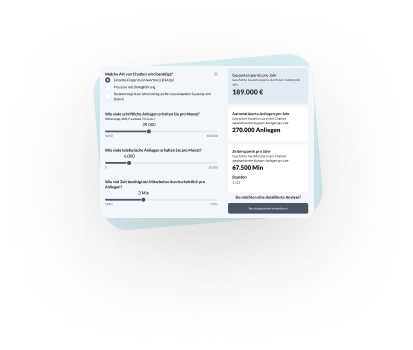
 AI Agent ROI Calculator
 Free training: Chatbot crash course
 Whitepaper: The acceptance of chatbots
AI Agent Prebuilds
–-> Go to BOTwiki
AI Agent Prebuilts are pre-configured sets of optimized instruction prompts, knowledge contexts, and behavioral guidelines (personas) that can be used directly for typical use cases on an AI agent platform.
They work like modular starter kits: instead of defining every agent dialogue and persona from scratch, you import an existing building block and adapt it to the specific use case. In BOTfriends X, this is made easier by the versioning feature, which allows versions to be exported and imported.
As a result, prebuilts significantly shorten the design and implementation phase of an AI agent and reduce the effort required to manage complex, generative interactions. For B2B projects where time-to-value is critical, prebuilts are an indispensable accelerator for building conversational AI based on large language models (LLMs).
Building a prebuilt
A modern prebuilt bundles various generative components into a reusable unit. Unlike traditional modeling of individual questions, the focus here is on the instruction prompt design and context control.
Typical components of an AI agent prebuild include:
-
Instruction Prompts & Personas: Predefined character descriptions and behavioral guidelines that determine how the agent behaves and interacts.
-
Agent-based workflows: Predefined processes for complex tasks (e.g., problem-solving steps) that help agents pursue goals autonomously.
-
Tool definitions: Interface templates (function calls) that allow the agent to perform actions directly in third-party systems.
Typical use cases
Prebuilts are used wherever established interaction patterns need to be covered before company-specific customization begins. Classic examples include professional welcome scenarios, identification and verification processes, automated appointment scheduling, and support assistants for specific industries. In practice, companies combine multiple prebuilts to, for example, link a “reception agent” with a specialized “support agent.”
Even though pre-built models are based on modern prompts, they need to be fine-tuned before going live. The predefined personas and knowledge sources are replaced by what is known as prompt engineering and specific company data to ensure that the tone and expertise align perfectly with the brand.
Prebuilt configurations in multi-agent setups
In modern architectures, prebuilts are used as building blocks within a multi-agent orchestration. In this context, specialized agents work together as a team: an authentication agent is set up using a corresponding template, while a product advisor agent is added using another template, before both are customized to the company’s needs. A higher-level instance controls the flow of context between these units.
This modular approach makes it possible to quickly scale standard tasks using proven pre-built components, while still leaving room for highly customized, data-driven AI applications.
Frequently Asked Questions (FAQ)
These are pre-built collections of system prompts, personas, and agent-based dialogue structures. They serve as a starting point for modern AI projects, allowing developers to draw on proven best practices in generative AI rather than having to rewrite every interaction logic from scratch.
No. Pre-built models provide the foundation and structure. Custom prompt engineering then ensures that the AI agent perfectly masters your company’s specific terminology, processes, and unique voice.
In such setups, prebuilds serve as “role profiles” for individual agents. You can think of them as job descriptions: a prebuild defines what an agent can do and how it behaves, so that it can be seamlessly integrated into a larger system consisting of multiple cooperating AI units.
–> Back to the BOTwiki