
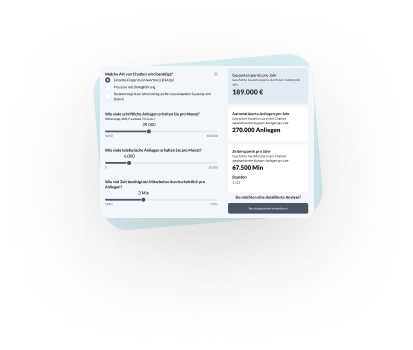
 AI Agent ROI Calculator
 Free training: Chatbot crash course
 Whitepaper: The acceptance of chatbots
AI Task
–-> Go to BOTwiki
An AI task is defined as a specific, AI-driven action within digital systems or workflows. These tasks are used to perform predefined operations based on artificial intelligence. In the context of BOTfriends X and Conversational AI, AI Tasks serve to improve interactions and make automation processes more efficient.
Key features of an AI task
An AI task is typically a modular function that is integrated into more comprehensive applications. Such tasks can be flexibly configured for various purposes, from text generation to data summarization and data formatting. Implementing an AI task enables systems to perform intelligent functions without having to program each step manually. This contributes to the scalability and adaptability of AI applications.
Use of AI tasks within conversational AI
In conversational AI, including chatbots and voicebots, AI tasks are used to handle complex interactions and optimize the flow of dialogue. For example, an AI task can classify a user’s intent, extract relevant information from a query, or generate personalized responses. This often involves using a knowledge baseto provide accurate and context-sensitive information. By offloading such specialized functions to AI tasks, the performance of bots can be significantly enhanced, enabling more natural and helpful conversations than before.
AI tasks in workflow automation
As part of workflow automation , AI Tasks serve as integral components that enrich automated processes with intelligence. They can be used to automatically process requests, generate reports, or dynamically adjust process steps. An example of this is the generation of structured data from unstructured text inputs, such as summarizing customer feedback or extracting key information from documents. The use of AI tasks in workflows leads to a reduction in manual effort and an increase in efficiency.
Examples of AI tasks
There are many practical applications for AI Tasks. In the BOTfriends X platform, for example, AI Tasks can be used to send an individual instruction directly to an LLM via prompt and save its response. In addition, a knowledge base can be queried directly to extract specific information. Furthermore, data can be summarized, translated, categorized, or converted into other formats. These examples show how AI Tasks can help meet a wide variety of requirements in automated environments and enrich interaction with systems.
Frequently Asked Questions (FAQ)
An AI task can perform a variety of specific, AI-driven functions. These include generating text for news articles or summaries, creating structured data sets from unstructured inputs, or classifying information. These functions help to make automated processes more intelligent and versatile.
AI tasks are integrated into automated workflows as modular building blocks. They can be called up at specific points in the workflow to perform a specific AI operation. This enables flexible automation design in which intelligent decisions or content are generated dynamically. The results of an AI task can then be fed directly into subsequent steps in the workflow.
Yes, AI tasks are capable of generating structured data. By specifying a desired structure, AI models can be instructed to output information in a defined format, for example as a JSON object with specific fields. This is particularly useful for further processing of data in other systems or for the automated creation of reports and analyses.
–> Back to the BOTwiki