
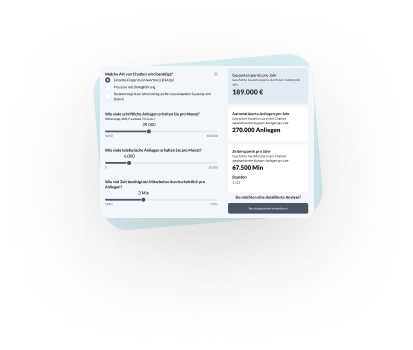
 AI Agent ROI Calculator
 Free training: Chatbot crash course
 Whitepaper: The acceptance of chatbots
AI workflows
–-> Go to BOTwiki
An AI workflow refers to a sequence of automated process steps controlled by artificial intelligence. Unlike traditional workflow automation, which is based on fixed if-then rules, AI workflows use machine learning, natural language processing (NLP) and predictive analytics.
They can process and interpret unstructured data such as emails, documents, or customer inquiries and make context-based decisions. An AI workflow typically consists of data input, AI-supported analysis, automated action, and continuous learning.
In companies, AI workflows are used in areas such as customer service, HR, sales, and IT, enabling scalable, intelligent process automation.
Why is an AI workflow important?
AI workflows offer significant efficiency gains for companies in Germany: they reduce manual workloads, minimize error rates, and accelerate decision-making processes. Especially in complex enterprise environments, where thousands of requests, tickets, or documents have to be processed every day, AI workflows enable automated process handling.
This leads to faster response times, better customer satisfaction, and higher employee productivity. In addition, AI workflows help to meet compliance requirements by ensuring standardized, traceable processes. In times of increasing automation requirements and a shortage of skilled workers, intelligent workflows are becoming a decisive competitive advantage for large German companies.
AI workflow in practice
In practice, AI workflows can be used in a wide range of applications: In customer service, an AI workflow analyzes incoming support requests, automatically classifies them according to urgency and topic, and forwards them to the appropriate employee or answers them directly via chatbot.
In the finance department, they process invoices, reconcile them with order data, and trigger payment approvals.
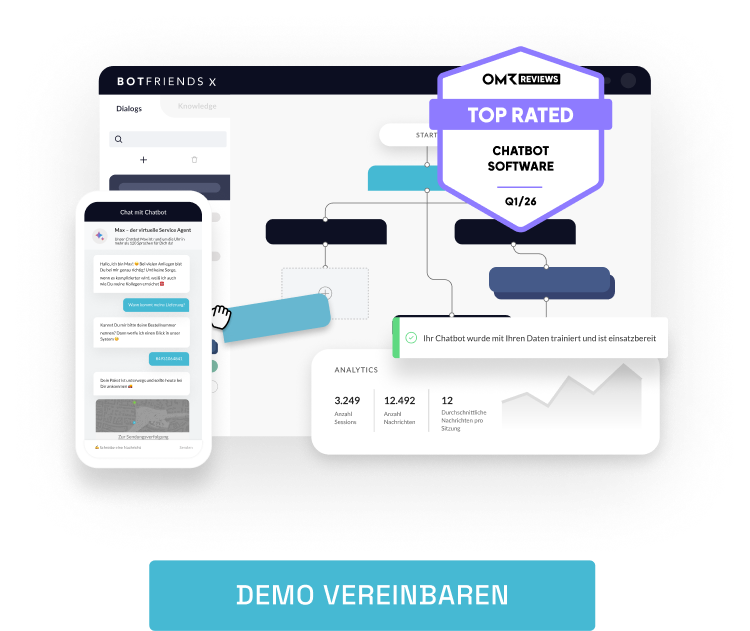
BOTfriends integrates such AI workflows into an AI agent platform and enables companies to use intelligent chatbots and voicebots. AI-supported dialogues are linked to backend systems, allowing users to submit requests in natural language and the AI workflow to handle the entire process—from data retrieval to process execution.
Frequently Asked Questions (FAQ)
Traditional automation follows rigid if-then rules and only works with structured, predictable processes. AI workflows, on the other hand, use machine learning and NLP to process unstructured data and understand context. This enables them to map more complex, flexible business processes.
An AI workflow is based on several AI technologies: machine learning analyzes patterns and makes predictions, natural language processing handles human language, and predictive analytics enables forward-looking process optimization. In addition, there are workflow orchestration tools that connect different systems, as well as APIs for integration into existing enterprise software. BOTfriends combines these technologies in its conversational AI platform to implement intelligent, voice-controlled workflows.
Implementation begins with identifying suitable use cases —ideally repetitive, data-intensive processes with clear decision points. This is followed by data preparation, selection of suitable AI models, and integration into existing systems. BOTfriends supports companies in gradually introducing AI workflows: from process analysis and the development of intelligent chatbot dialogues to connection to backend systems. Continuous monitoring and iterative optimization are important for sustainable efficiency gains.
–> Back to the BOTwiki