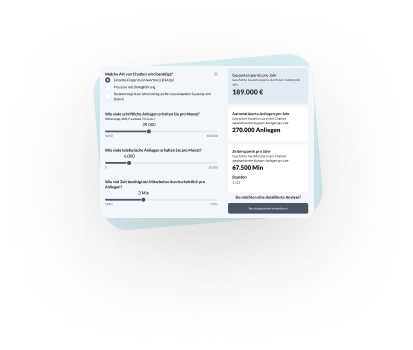
 AI Agent ROI Calculator
 Free training: Chatbot crash course
 Whitepaper: The acceptance of chatbots
Are increasing call volumes overloading your customer service and robbing your qualified employees of time for routine inquiries? Automate your customer communication and make your service fit for the future.
This guide explains without technical gobbledygook how to seamlessly integrate an intelligent AI voicebot into any telephone system via SIP connections and APIs.
Integration of a voicebot into your telephone system
Your customer service has a tough time these days: call volumes are rising inexorably, customers expect immediate help at any time, and your qualified employees are hopelessly overloaded with repetitive routine inquiries.
By integrating an intelligent AI voicebot into your existing telephone system, you can remedy the situation and free up your team for the really important issues.
In this guide, we explain how to integrate a voicebot into your telephone system without any technical gobbledygook and why this is the decisive step in making your customer service fit for the future.
The power of the Voicebot telephone system: How does integration work?
Thanks to standardized protocols, this process is no longer witchcraft. Essentially, it is about building a stable bridge between traditional telephony and modern AI. Two key technologies in particular are of central importance here: SIP connections and APIs.
SIP Connections are the heart of the audio connection, acting as a multi-lane digital highway directly to the Voicebot platform. They replace the old, physical ISDN lines with a digital, virtual telephone connection that runs via your Internet connection.
When a call is received on your service number, your telephone system does not forward this call to a human agent, but directly to the voicebot via the SIP connection. The system can dynamically and highly scalably adapt these "lines" to your call volume, which is perfect for seasonal peaks or fast-growing companies.
So while the SIP connection provides the audio connection, APIs (Application Programming Interfaces) are the data interfaces. The bot uses APIs to connect to your critical backend systems such as CRM or ERP in real time. For example, if a customer provides their customer number, the AI agent sends this to your CRM via API, authenticates the caller and can greet them personally.
The question of whether your telephone system is operated locally at your company (on-premise) or in the cloud influences the integration strategy.
Cloud telephone system
Systems such as Microsoft Teams, Genesys Cloud or Aircall are often easier to integrate. They are digital by nature and usually offer standardized interfaces.
On-premise telephone system
Older, local systems (e.g. from Avaya, Unify) can also be connected. This usually requires a so-called Session Border Controller (SBC), which acts as a secure "gateway" between your internal network and the external SIP connection of the Voicebot provider.
Advantages of Voicebot integration: efficiency, scalability & customer satisfaction
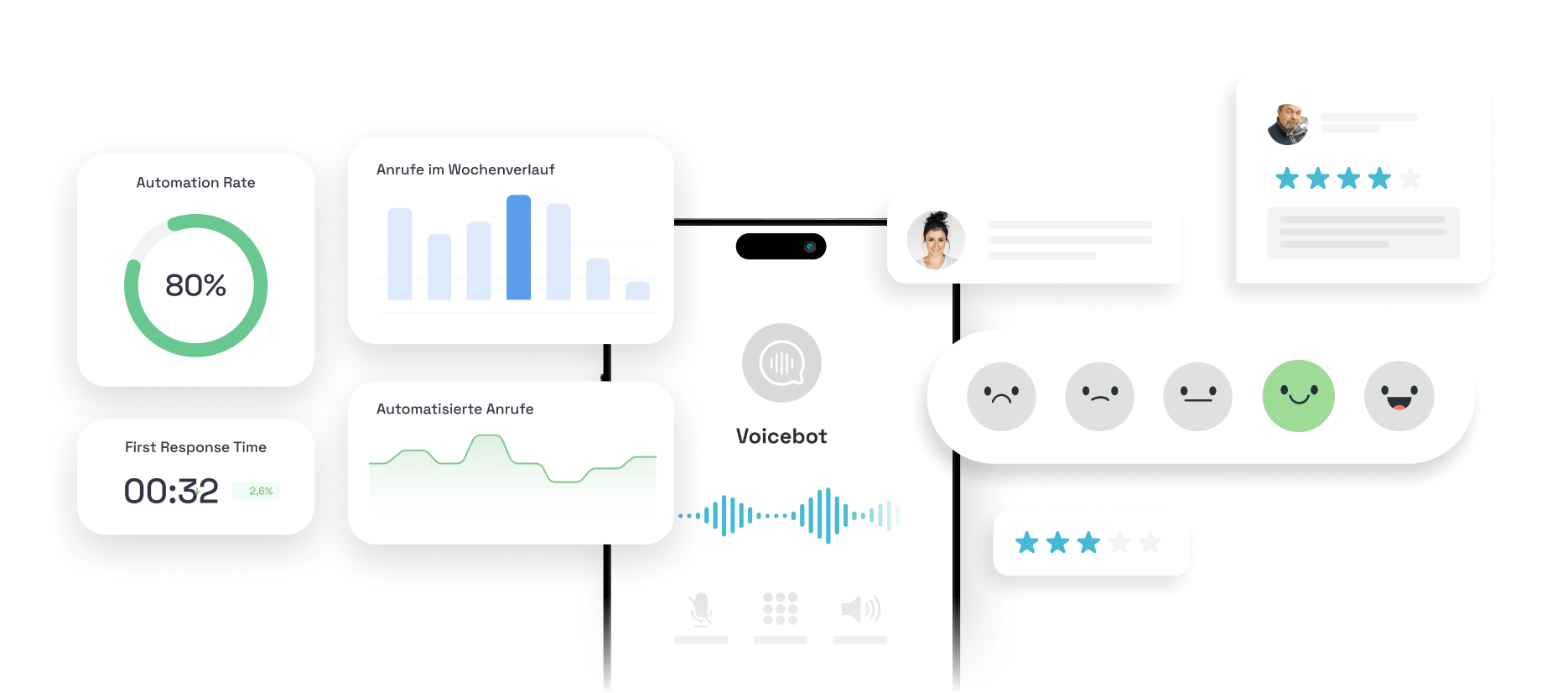
Integrating an AI voicebot into your telephone system is a strategic move that will transform your customer service in the long term. The quantifiable benefits go beyond pure cost savings. Let's take a look at some specific KPIs that are positively influenced by integration:
First Contact Resolution (FCR)
A voicebot that uses artificial intelligence for incoming calls can handle a large number of standard inquiries completely and conclusively in the first contact. An increase in the FCR rate by just a few percentage points has a direct impact on customer satisfaction.
Average Handling Time (AHT)
The pre-qualification of concerns by the AI bot drastically reduces the AHT for your human agents. The bot collects all relevant information in advance so that the agent is immediately in the picture and can start finding a solution straight away instead of requesting basic data.
Cost per call (CPC)
A fully automated call by a voicebot costs only a fraction of the cost of a call handled by an employee. This enables a massive reduction in your budget while improving service at the same time.
In addition to these concrete key figures, this change signals that you value the time of your customers and your employees.
Application examples for voicebots
An AI voicebot offers a wide range of use cases that can be implemented immediately to achieve measurable success quickly. The ideal starting point is the automation of high-volume, low-complexity processes.
One of the most common and effective use cases is the automation of call identification and pre-qualification. Instead of sending the caller through a rigid IVR menu, the voicebot asks the request in natural language and identifies the customer through simple authentication questions.
Status queries and standardized processes are also ideal for voicebots. These include querying the order status with the order number, making appointments or reporting a meter reading in the supply area. The bot accesses the ERP system directly via APIs and can output the information in real time.
Automating the answering of frequently asked questions (FAQs) is also an immediately profitable use case. Many customer service calls revolve around recurring, standardized topics and taking over these queries frees up employee resources. Employees can therefore concentrate on more complex issues that really require human expertise.
How your voicebot implementation works with BOTfriends
At BOTfriends, we rely on a structured, 5-phase roadmap that ensures maximum ROI.
Phase 1: Analysis & strategy - defining the right use cases
Start with the question "Where do we have the biggest pain points?" and analyze your call data:
- Which 5-10 questions are asked most frequently?
- For which requests is the process highly standardized and rule-based?
- Where do the longest waiting times or the highest call volumes occur?
Identify 1-2 "lighthouse projects" with a high volume and low complexity. The aim is to achieve quick wins in order to create acceptance within the company and demonstrate ROI at an early stage.
Phase 2: Concept & dialog design - Designing the brain of your voicebot
In the next phase, you design the conversations and breathe life into your voicebot. This involves the following topics:
- Persona: How do you want your bot to sound? Friendly and relaxed or more formal and businesslike? The tonality should match your brand.
- Dialogue management: Don't just plan the "happy path" where the caller does everything right. What happens if the bot doesn't understand an answer? How does it ask politely? How and when does it offer to transfer the call to a human?
- Backend integration: Define exactly which data from which systems (CRM, ERP, etc.) is required at which point in the dialog.
Phase 3: Technical implementation & connection
This is where the concept is put into practice. The IT department or your implementation partner such as BOTfriends configures the technical interfaces.
The most important step is setting up the SIP connection between your telephone system and the Voicebot platform. At the same time, the API connections to your backend systems defined in phase 2 are developed and tested.
At this stage, close cooperation between your customer service expert, IT and the voicebot provider is crucial.
Phase 4: Testing & quality assurance - The devil is in the detail
Before the AI voicebot is unleashed on your customers, it has to be put through its paces.
- Functional tests: Do all dialog paths work as planned? Is data retrieved and displayed correctly from the systems?
- Speech recognition tests: Test with different speakers, dialects, background noises and unclear pronunciation.
- Load tests: What happens if 100 calls are received at the same time instead of 10? The scalability of telephone support must be ensured and you should also involve customer service staff in the tests. They know the pitfalls and typical formulations of your customers best.
Phase 5: Go-live & continuous optimization
The go-live is not the end of the story. Initially, only route a small percentage of calls to the bot or switch it live for just a few hours. Then monitor the performance dashboards closely, even with a constant live connection, and make constant improvements:
- How high is the automation rate?
- At what points in the dialog do users drop out?
- Which requests could the bot not understand?
BOTfriends is your strategy partner for future-proof customer service
With BOTfriends, you have a strategic partner at your side who masters both the complexity of telecommunications and the intricacies of dialog management. With our structured 5-phase roadmap, we offer a proven methodology that ensures maximum ROI from data-driven analysis of pain points to continuous optimization.
As an experienced German provider, we attach great importance to legally compliant implementation: By using our GDPR-compliant AI Agent platform and hosting solutions in the EU, we ensure that the processing of sensitive customer data on the phone also complies with strict European data protection regulations at all times.