
 AI Agent ROI Calculator
 Free training: Chatbot crash course
 Whitepaper: The acceptance of chatbots
Many AI projects involving chatbots and voicebots fail not because of the technology itself, but due to a lack of strategy in the preparation, implementation, and post-launch phases. This article outlines the specific steps companies must take at each project phase to successfully implement conversational AI projects.
Why AI Projects Fail and What's Really Behind It
The hype surrounding conversational AI is real—and so are the disappointments. Many companies embark on AI projects with great enthusiasm, only to find that the bot doesn’t live up to its promises. Yet more often than not, this isn’t due to the technology itself.
Projects often fail because of strategic gaps that arise long before the first deployment. But with the right partner by your side, you don’t have to go it alone.
In this article, we examine what companies should keep in mind during the various phases of their voicebotor chatbot project in order to ultimately achieve efficiency and a satisfactory outcome.
Phase 1 – Preparation: The foundation is everything
The most important decisions are made before the first dialog is configured. Taking the time to think things through now will save you valuable time and money later on.
- Assess your budget and in-house resources realistically: A bot is not a one-time investment. In addition to licensing and implementation costs, you’ll need internal resources for maintenance, further development, and quality assurance. This must be factored into your plans from the very beginning.
- Define the use case before you get started: Which contact channels do customers use most frequently? Where are the pain points in customer service? Which inquiries take up the most of employees’ time each day? Conversational AI delivers its greatest value where real friction points exist. A thorough analysis of contact patterns, wait times, and common concerns sets the direction—and protects against costly misinvestments.
Theory Meets Practice: How Ticket Online Developed Its Use Case
In our case study, Felix from Ticket Online walks you through the entire project process and offers valuable tips for anyone planning a similar project.
- Get stakeholders on board early: Bot projects often fail not because of a lack of budget, but because of a lack of internal support. IT, data protection, customer service, and management must be involved early on. Otherwise, resistance will arise just when things get critical.
- Choosing the right provider: The success of an AI project hinges on choosing the right provider for the specific company:
Organizations with large-scale operations and complex IT infrastructures need an enterprise-level provider that offers dedicated IT support.
If you want to start small and stay agile without automating extensive or complex processes, a lightweight entry-level solution is the better choice.
When flexibility and depth are equally important, it’s worth choosing the happy medium with a provider like BOTfriends. While entry-level solutions for real-world business processes quickly reach their limits, BOTfriends offers enterprise-grade technology through multi-agent orchestration—but without the price tag and implementation overhead of traditional enterprise platforms.
Phase 2 – Implementation: Structure Trumps Enthusiasm
Successful projects thrive on clear lines of responsibility, realistic time estimates, and collaboration that doesn't get bogged down in endless email exchanges.
- Designate clear points of contact: A bot project needs one or more internal leads who are not only nominally responsible but also have the actual capacity to handle it. Anyone who has to juggle the project alongside other tasks will not be able to see it through to a successful conclusion.
- Address technology issues early on: Telephone connections, CRM integrations, SSO systems: If you wait until late in the project development phase to address these issues, you risk delays that can drag on for weeks.
- Establishing effective communication between the team and the vendor: Short coordination cycles, a shared understanding of objectives, and direct lines of communication are measurable factors for success. Projects with poor communication have been shown to take longer and cost more.
- Set deadlines and take them seriously: By setting binding milestones, you can protect your project from the creeping stagnation that spells the end for many AI initiatives.
- Pilot phase before full rollout: Launching a bot directly for all channels and topics is risky. For phonebots, for example, it makes sense to initially go live only on an hourly basis outside of service hours and test them in order to optimize them iteratively. AI agents can also be introduced gradually by first launching them within a defined topic area or user group and then rolling them out further and further. This significantly reduces risks and provides valuable insights.
Phase 3 – After Go-Live: The bot never stops learning
The launch of the AI agent isn't the end of a project, but rather the beginning of the most critical phase of work. After all, the best bots on the market aren't necessarily the ones that were deployed most effectively, but rather the ones that have been refined most consistently.
- View continuous optimization as an integral part of the product: A chatbot or voicebot is not a static system. Language, customer needs, and processes are constantly changing, and the bot must keep pace. Those who view optimization as an ongoing process will consistently get more out of it.
- Identify and resolve issues quickly: No system is perfect right after its initial rollout. Regularly monitoring drop-off rates, escalations, and user feedback helps identify areas that need improvement early on, before small bugs turn into major frustrations.
- Add features that customers really want: The most valuable product ideas often come from the conversation data itself. What are users asking that the bot can’t do yet? Systematically closing these gaps is one of the most powerful ways to drive long-term ROI.
- Measuring success and communicating it internally: If you don’t demonstrate the value of a bot, you risk having the budget cut during the next planning cycle. Clear KPIs such as containment rate, CSAT, or reduced workload for the team help demonstrate results and establish the project’s value within the organization.
- Using the bot as a data source: Conversation data is gold because it reveals what customers are really concerned about, the language they use to ask questions, and where information is missing on the website or in the product. Analyzing this data provides insights that go far beyond the bot itself.
Conclusion: Failure is not inevitable
AI projects don’t fail because the technology doesn’t work. They fail because the framework is missing: no clear use case, no ownership, and no continuity after launch. Those who take these three phases seriously lay the groundwork for a bot that truly makes an impact.
That might sound like a lot at first, and yes, it is a serious undertaking. But no one has to go through it alone. A good implementation partner supports you not only with the technology but also with the strategy: from the initial use-case analysis through to ongoing development after the go-live.

Are you ready to take your AI strategy to the next level?
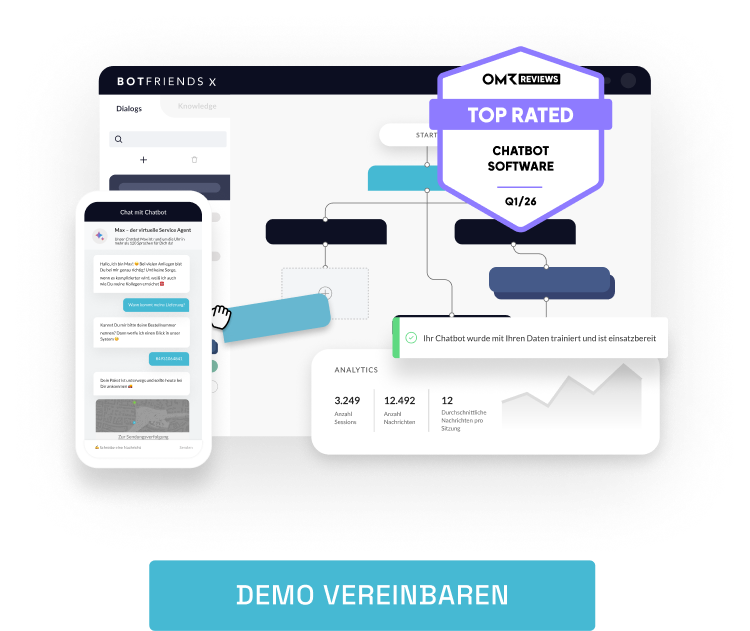
Join a personalized demo to learn how you can use the BOTfriends X platform to build sophisticated multi-agent systems that reduce the workload on your business units and delight your customers.