
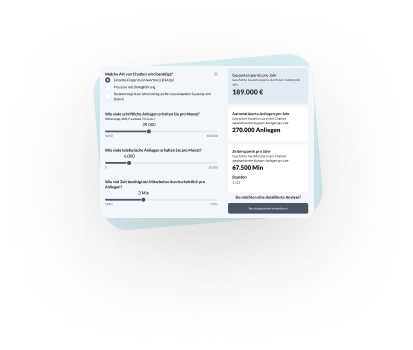
 AI Agent ROI Calculator
 Free training: Chatbot crash course
 Whitepaper: The acceptance of chatbots
Multi-agent orchestration, as used in BOTfriends, is more sustainable than single-agent systems, as specialized AI agents solve complex tasks with greater precision and are easier to maintain. Through a central router and shared contextual knowledge, they enable seamless handoffs and prevent malfunctions in the overall system when local changes are made.
Why Multi-Agent Orchestration Is the Future of Sustainable AI Sovereignty
Once companies have decided to automate their customer service or certain business processes using AI, they often face a fundamental choice: Should we build a “super-bot” that can do everything, or should we rely on a team of specialized experts?
Many early AI projects fall into the trap of monolithic design. They attempt to handle all service requests—from simple FAQ answers to complex backend transactions—within a single, often overloaded agent. The result is often a fragile system that becomes difficult to maintain as complexity increases and triggers unpredictable chain reactions at the slightest change in the prompt.
Identifying these pain points inevitably leads to a strategic shift away from rigid “lone-wolf bots” toward harmonious multi-agent orchestration.
The Principle of Specialization: What Sets Multi-Agent Orchestration Apart

Modern multi-agent orchestration works like a well-managed team of experts. Instead of a generalist who understands “a little bit of everything,” specialized AI agents are deployed for specific tasks. At the heart of this system is a central routerthat recognizes the user’s intent and instantly routes the request to the most suitable specialized agent.
A typical scenario in an automated service environment looks like this:
- Issue Detection & Routing: An initial agent receives the message (voice, chat, or email), analyzes the context, and forwards it to the appropriate specialist.
- Specialized agents: For example, Agent A specializes in authenticating and identifying customers, while Agent B performs deep read-write operations in backend systems such as ERP or CRM.
- Seamless handoff: It is crucial for the customer experience that the handoff between these agents remains invisible to the user.
Key to the success of this model are clear responsibilities. Each agent operates within defined guardrails and behavioral guidelines, which drastically reduces the likelihood of errors. This segmentation ensures that the AI does not attempt to solve problems outside its area of expertise and potentially hallucinate.
Orchestration in Practice: How BOTfriends Implements Multi-Agent Systems
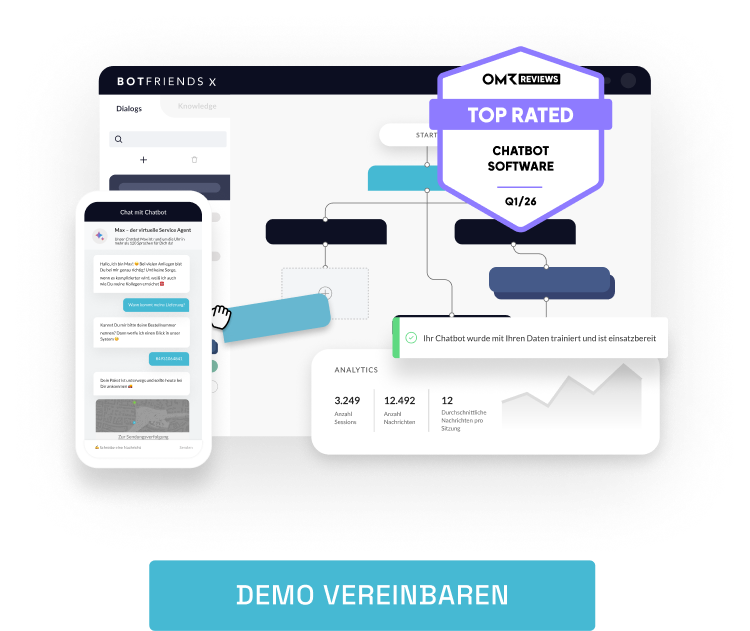
We provide companies with a powerful platform that enables them to manage complex multi-agent structures themselves using no-code technology.
To ensure full control over the entire automation strategy, our architecture is also based on the principle of Hybrid Intelligence: the combination of autonomous AI agents with secure, rule-based business logic.
The implementation on the BOTfriends X platform offers significant advantages:
- A central "AI brain" with shared knowledge: All agents can access a central knowledge base, which enables Holistic Unification across all channels. At the same time, however, access can be controlled at a granular level. This way, an agent searches only the knowledge areas that are truly relevant to it, which increases efficiency and reduces costs for token consumption.
- Shared contextual knowledge: Within a conversation, agents share a consistent memory. This prevents the customer from having to provide information multiple times, for example, when switching from a “routing agent” to a “transaction agent.”
- BOTfriends Managed LLM: To ensure the best possible performance of your multi-agent architecture, we use BOTfriends Managed LLM option, we use the best-tested model for each specific task. Those who prefer maximum control, however, can use our model-agnostic approachto specify a custom LLM for the entire project and thus avoid vendor lock-in.
Long-term benefits: Why teams of agents outperform monolithic systems
Working with specialized AI agents is not only technically more elegant, but also more economically sustainable in the long term. The biggest advantage lies in traceability and maintainability. If an error occurs in a monolithic system, the exact cause is often difficult to pinpoint. In a multi-agent environment, however, problems can be precisely attributed to a specific agent and resolved there in a targeted manner without jeopardizing the entire system.
Other strategic advantages include:
- Targeted optimization: Changes to task handling or the role of an individual agent do not have any unforeseen effects on other areas.
- Modular scalability: New use cases can be easily integrated into the existing network as additional agents, rather than having to laboriously modify an existing bot.
- Resilience: If a component fails due to a faulty API integration, the rest of the infrastructure (e.g., basic routing or FAQ answers) remains fully functional.
In contrast, there is the so-called “Swiss Army Knife Fallacy,” which assumes that a good AI agent must be as versatile as a real Swiss Army knife. However, an agent that is expected to do everything often becomes imprecise and slow.
This becomes particularly critical with single-prompt agents, whose entire set of behavioral instructions and task descriptions is contained in a single, massive prompt and which operate without proper orchestration. These tend to lose focus, mix up instructions, and ultimately fail to provide the reliability required for true dark processing in the enterprise sector.
Would you like to know more about why single-prompt agents aren't enough for sustainable automation? Read our article on this topic here.
Our conclusion
Anyone who wants to implement sustainable customer service automation must move away from the idea of a single, all-knowing chatbot or voicebot .
The future belongs to multi-agent orchestration, which enables true deep process automation through specialization, clear structures, and seamless collaboration.
With the right platform, companies gain full control over their AI processes, minimize risks such as hallucinations, and establish a scalable foundation for excellent CX.

Are you ready to take your AI strategy to the next level?
Join a personalized demo to learn how you can use the BOTfriends X platform to build sophisticated multi-agent systems that reduce the workload on your business units and delight your customers.