
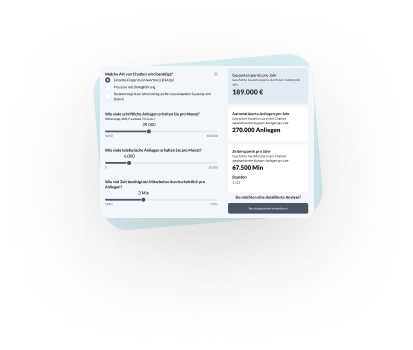
 AI Agent ROI Calculator
 Free training: Chatbot crash course
 Whitepaper: The acceptance of chatbots
The successful implementation of AI agents requires systematic identification of high-impact areas, validated by user stories and clear KPIs such as ROI and efficiency gains.
Ithe following, we will show you step by step how to identify use cases and evaluate them in terms of technical feasibility, strategic alignment, and measurable customer benefits in order to automate complex processes in customer service or internal help desks in a sustainable manner.
How do you define an AI agent use case?
The implementation of AI has become a necessity in business processes, particularly in order to make customer service efficient and sustainable. AI agents in particular are becoming increasingly popular as a fully-fledged automation option for complex processes.
But with the seemingly endless possibilities for using AI agents such as chatbots and voicebots and defining specific use cases, many executives face a challenge: where to start? It's easy to get excited about the technology, but the real art lies in identifying and prioritizing an actual initiative that delivers real business value and has a realistic chance of success.
This is exactly where we want to help and show you how to proceed systematically to successfully define and evaluate your AI agent use case.
In our interactive Use Case Check, you can also find out how mature your use case already is and how you should proceed.
Step 1: Identifying an AI agent use case
The search for the right use case often begins with a pain point analysis. An agent is useful when a task requires cognitive flexibility but is still repetitive.
Where you should look:
- Customer service structures: Service processes with low complexity, which, due to their volume, result in overloads in the service team and enormous waiting times for customers.
- Bridging data silos: Tasks that require information to be extracted from unstructured sources (emails, PDFs) and entered into structured systems (SAP, Salesforce).
- Triaging & pre-filtering: Processes that require an initial assessment before an expert takes over (e.g., IT support tickets or insurance claims).
- Research & synthesis: When employees spend hours searching internal knowledge databases to prepare a basis for decision-making.
Checklist: Does the process have clear input data? Does it require access to external tools? Is there a clear goal? If so, it is an agent use case.
The critical point here is validating the necessity: Is AI really the best solution, or is there a simpler, more cost-effective alternative that solves the problem just as well?
Take the time to precisely define the type of interaction (e.g., pure self-service, support for human agents, or a mixture) to ensure that the initiative is optimally tailored to the company's requirements. This is the only way to avoid developing a complex AI solution for a simple problem.
Step 2: Writing a user story
To build the agent, we need to understand who it works for and what the goal is. A classic user story helps to focus on user value.
The simple formula here is:
"As [role], I want [action/AI support] so that [benefit/result]."
- [Role]: Defines the target group (e.g., VIP customer, new employee, service agent).
- [Action/AI Support]: Describes the specific functionality provided by the agent (e.g., checking order status, summarizing complex documents).
- [Benefit/Result]: Explains the added value or the goal that is achieved (e.g., getting a faster response, being able to focus on complex cases).
Example:
"As a customer, I want be able to check my return statusso that I don't have to wait on hold ."
or
"As a service employee, I would like to receive help from an AI agent when responding to repetitive emails so that I can focus my energy on more complex issues."
This format forces a clear focus on benefits and prevents the project from getting bogged down in trial-and-error mode. It ensures that every AI function is directly aligned with a measurable advantage.
By writing these stories, you create a shared, easily understandable vision that brings everyone involved in the project together. In doing so, you not only define what the agent should do, but above all, for whom and why it is important.
Step 3: Identification of the ROI
AI projects often fail because the financial or strategic benefits remain unclear. Therefore, defining an AI agent use case is only sustainable if a clear return on investment (ROI) can be demonstrated. Identifying the relevant key performance indicators (KPIs) and establishing a baseline are crucial for measuring the actual business value added by the AI initiative.
The ROI of an AI agent can manifest itself in various dimensions:
- Costs and efficiency:
- Response time (e.g., first response time, average handle time): Shorter processing times lead to lower operating costs.
- Reduction in manual workload: Automating Tier 1 requests by an agent leads to direct savings in human resources.
- Customer satisfaction:
- Net Promoter Score (NPS), Customer Satisfaction (CSAT), Customer Effort Score (CES): Faster, more consistent, and 24/7 availability of support can measurably increase customer loyalty.
- Revenue generation:
- Conversion rates, retention rates: Personalized recommendations or proactive support from agents can have a positive impact on sales.
In order to assess success, it is necessary to setting a baseline is essential. Document the current status of your KPIs before implementing the AI agent ("Where are we today?").
Only by directly comparing the metrics before and after implementation can you validatethe actual benefits of the AI agent use case implementation in retrospect .
You can use our ROI calculator to calculate the return on investment of your AI agent project in advance.
Step 4: Define the scope of application for the AI agent use case
An agent who can do "everything" usually can't do anything properly. Define clear guardrails to minimize risk and increase accuracy.
- Channels: Through which channels should the AI agent be accessible? (Phone, chat, email) And where should it be embedded? (Website, service hotline, intranet)
-
Input sources: What data should the agent have access to? (e.g., only PDFs from folder X).
-
Tool access: Is the agent permitted to send emails directly or only save drafts? (Human-in-the-loop).
-
Out-of-scope: What should the agent explicitly not do? (e.g., not negotiate prices).
Examples of areas of application:
The areas of application extend far beyond simple chatbots and affect almost all areas with high, recurring communication or data management needs.
In customer service and CX:
- Automated first contact:AI agents can resolve up to 80% of standard inquiries such as password resets, status queries, or simple complaints completely autonomously via chat, email, or voice channels.
- Agent assistance: The AI agent supports human employees by retrieving relevant information from the knowledge base in real time, creating conversation summaries, or even suggesting responses. This drastically reduces average handle time.
- Targeted escalation: By analyzing the issue in incoming tickets or requests, the AI agent can automatically escalate the issue to the right contact person and retrieve the most important information in advance so that only pre-qualified tickets and conversations are passed on to human employees.
In other areas of the company:
- Internal help desks:AI agents assist employees with common IT inquiries, HR forms, orself-service for internal processes by summarizing documentation and providing instructions.
- Data enrichment and personalization in marketing: An AI agent can collect and analyze customer data from interactions and use it to derive personalized recommendations for marketing campaigns, thereby strengthening cross-selling and upselling opportunities.
Choosing the right application area for the AI agent depends heavily on where the highest implementation feasibility (existing data and systems) meets the highest expected ROI.
Successful implementation often requires integrating the agent with existing internal systems (CRM, ticketing, knowledge databases) in order to equip it with all necessary actions.
BOTfriends Best Practices
At BOTfriends, we know that defining an AI agent use case is just the beginning. Success depends on a strategic approach tailored to the company.
Use four-dimensional evaluation:
Before you start with broad implementation, each AI agent use case must be systematically evaluated. Based on Quiq's blueprint "How to Identify + Evaluate Agentic AI Use Cases," we recommend evaluating along four key dimensions to obtain a balanced picture:
- Implementation feasibility: Are the systems, data, and team technically ready for implementation?
- Expected ROI: Are the financial or operational benefits clear and significant?
- Customer impact: Is a relevant customer problem solved and the experience significantly improved?
- Strategic alignment: Does the use case fit with the company's long-term goals and is it scalable for future innovations?
Questions about each dimension are rated on a scale of 1-5. An overall score then determines the best course of action.This structured AI agent use case assessment reduces the risk of misinvestment and ensures that you focus on the use cases with the highest potential.
topic
Your result
Our tip – start with a targeted pilot project:
Even a promising use case requires caution. A focused pilot project is the right way to test feasibility and validate viability before rolling out the project for broad implementation.
BOTfriends as your strategic partner:
Defining your use case is just the beginning of your AI automation journey. With our flexible AI Agent Platform , we offer you not only market-leading technology, but also accompanying expertise.
BOTfriends combines the power of an enterprise AI platform with maximum independence by securely automating complex voice, chat, and email processes through reliable orchestration all the way to the backend. Thanks to our no-code architecture and guided sovereignty approach , you retain full process control and achieve fast results without relying on expensive integrators or high operational overheads.
Even if your use case received a low rating in the interactive check or you are still facing a "black box," we invite you to contact us. Together, we will analyze your initial situation and develop a roadmap that combines technological feasibility with real business value.
Are you ready for your AI agent journey? We can help you get started.
Schedule a no-obligation consultation and learn about our GDPR-compliant AI platform for voice, chat, and email automation.