
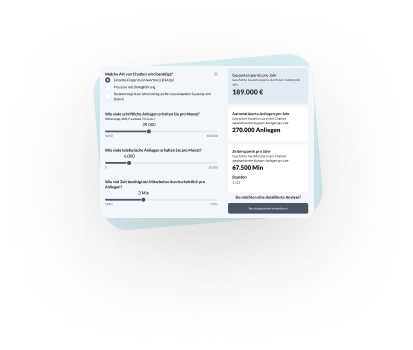
 AI Agent ROI Calculator
 Free training: Chatbot crash course
 Whitepaper: The acceptance of chatbots
Conversational AI Platform
–-> Go to BOTwiki
A conversational AI platform is a software system that enables the development and operational management of digital assistants for voice, chat, and email channels. It combines components for dialogue design, integration with backend systems, and the ongoing monitoring of AI agents.
In B2B DACH projects, it ensures that a voicebot on the hotline and a chat assistant on the service portal both use the same knowledge base. A modern conversational AI platform meets both the business and technical requirements of a scalable AI-native voice and chat strategy.
Components of a Conversational AI Platform
A conversational AI platform consists of several closely integrated layers. At its core is an NLU component that understands user input, recognizes intents, and extracts entities. This is complemented by a dialogue management system that controls the flow of the conversation, as well as a knowledge AI layer that integrates structured and unstructured knowledge.
In addition, there are components for AI workflows, human handover, analytics, and ongoing training. A no-code conversation editor enables even non-technical teams to maintain dialogues, while open APIs allow integration with CRM, ERP, and ticketing systems.
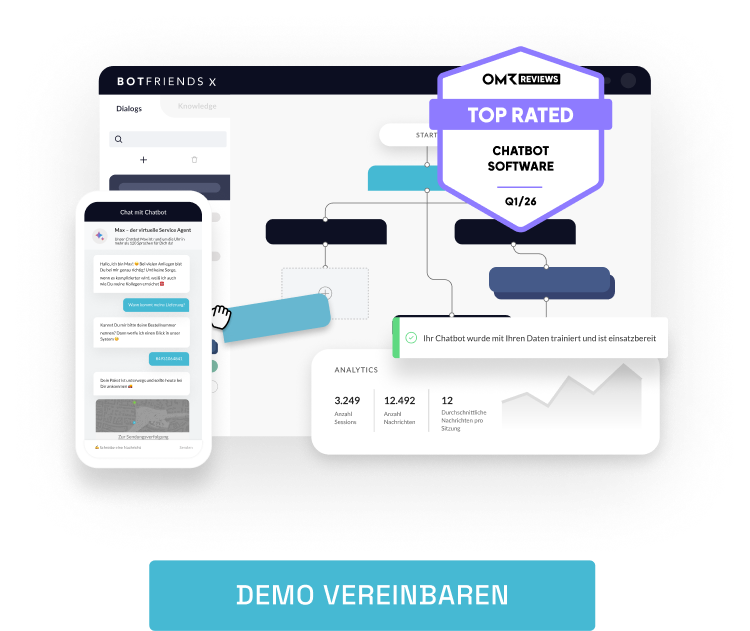
BOTfriends X vs. Traditional Chatbot Tools
Traditional chatbot tools are typically designed for a single channel and simple question-and-answer patterns. A conversational AI platform like BOTfriends X goes significantly further and supports complex use cases across multiple channels and systems. A key feature is its platform-based approach, which unifies voice, chat, and email under a single, consistent logic.
- Multi-channel support for voice, chat, and email with a shared knowledge base.
- Hybrid intelligence combining rule-based business logic and agent-based dialogues.
- Multi-agent orchestration using specialized AI agents for business units.
- Operational tools for monitoring, training, and continuous improvement.
- Open interfaces for integration with telephony, CRM, and knowledge sources.
Implications for Voice and Chat
In the voice channel, the platform determines whether a voicebot is actually effective in a hotline triage. In this scenario, a traditional IVR is a body without a brain, guiding callers through rigid menus. AI-native voice, based on a conversational AI platform, on the other hand, provides the brain: speech understanding, context memory, and multi-agent orchestration work together so that a caller can speak naturally and still be reliably routed to the right place.
The chat and email channels both use the same logic to access a shared knowledge base. This ensures that inquiries regarding billing addresses are answered consistently, regardless of whether they are received by phone, through the service chat, or via email.
If you'd like to delve deeper into input processing, you'll find more detailed explanations in the article on Natural Language Understanding.
Conversational AI Platform in Multi-Agent Setups
In larger service organizations, a single AI agent is rarely sufficient to handle the full range of customer inquiries. A conversational AI platform therefore supports multi-agent setups in which specialized agents handle topics such as orders, complaints, or billing. A central orchestration system routes inquiries to the appropriate agent, consolidates responses, and maintains consistency in the conversation. The result is a modular architecture that can be expanded incrementally without compromising the existing knowledge base.
At the operational level, the strength of such a platform is particularly evident when combined with hybrid intelligence. Generative language models handle open-ended queries, while rule-based business logic safeguards critical processes such as identity verification or payment authorization. This allows conversational AI to be deployed reliably in regulated industries such as insurance, banking, or energy without relinquishing domain expertise.
Frequently Asked Questions (FAQ)
A conversational AI platform is a software system used to develop, integrate, and operate digital assistants for voice, chat, and email channels. It combines natural language processing, dialogue management, knowledge integration, and operational tools within a unified architecture. As such, it serves as the technical foundation for scalable AI agent strategies.
It’s worth the investment as soon as you need to support multiple channels, use cases, or departments. Even though AI agents are operated, measured, and refined over the long term, a platform-based architecture is essential. Standalone solutions reach their limits—at the very latest—when voice, chat, and backend systems need to work together.
–> Back to the BOTwiki