
 AI Agent ROI Calculator
 Free training: Chatbot crash course
 Whitepaper: The acceptance of chatbots
In 2026, choosing between male and female AI voices in customer service will be a strategic design decision that uses unconscious archetypes to control customer satisfaction (CSAT) and de-escalation.
While over 60% of users prefer female voices, modern enterprise solutions rely on model-agnostic approaches and multi-agent orchestration to combine brand-specific identities with high problem-solving skills (agentic resolution).
The psychology of the perfect AI voice in customer service in 2026: male or female?
The voice of your AI agent is not purely a technical feature, but rather the audible identity of your company and the physical manifestation of your brand intelligence. So when a customer calls your service center and the voice sounds unnatural or contextually inappropriate, trust plummets in milliseconds.
When building a voicebot, there comes a point when you have to decide between a male or female voice. But which of the two is more suitable for your company? The decision should not be purely a matter of taste, but rather a strategic design decision at the intersection of psychology, brand impact, and user expectations.
Therefore, we will provide you with some information and empirical values below to help you make your decision.
The most important information in brief:
- Dominance: Over 60% of German users prefer female voices for digital assistants.
- Psychology: Female voices often trigger associations with warmth and empathy, while male voices trigger associations with authority and technical competence.
- Context sovereignty: The choice of voice must be appropriate for the use case (e.g., complaint management vs. IT support).
- Technology: Thanks to model-agnostic approaches, companies can now use state-of-the-art synthetic voices that are virtually indistinguishable from human speakers.
- ROI focus: The voice is the interface, but the agentic resolution (problem-solving skills) in the backend determines the success of the CX strategy.
Status Quo 2026: What users really want to hear
User preferences are not a coincidence, but the result of years of conditioning by Big Tech. Data from Bitkom Research and current market analyses for 2026 paint a clear picture:
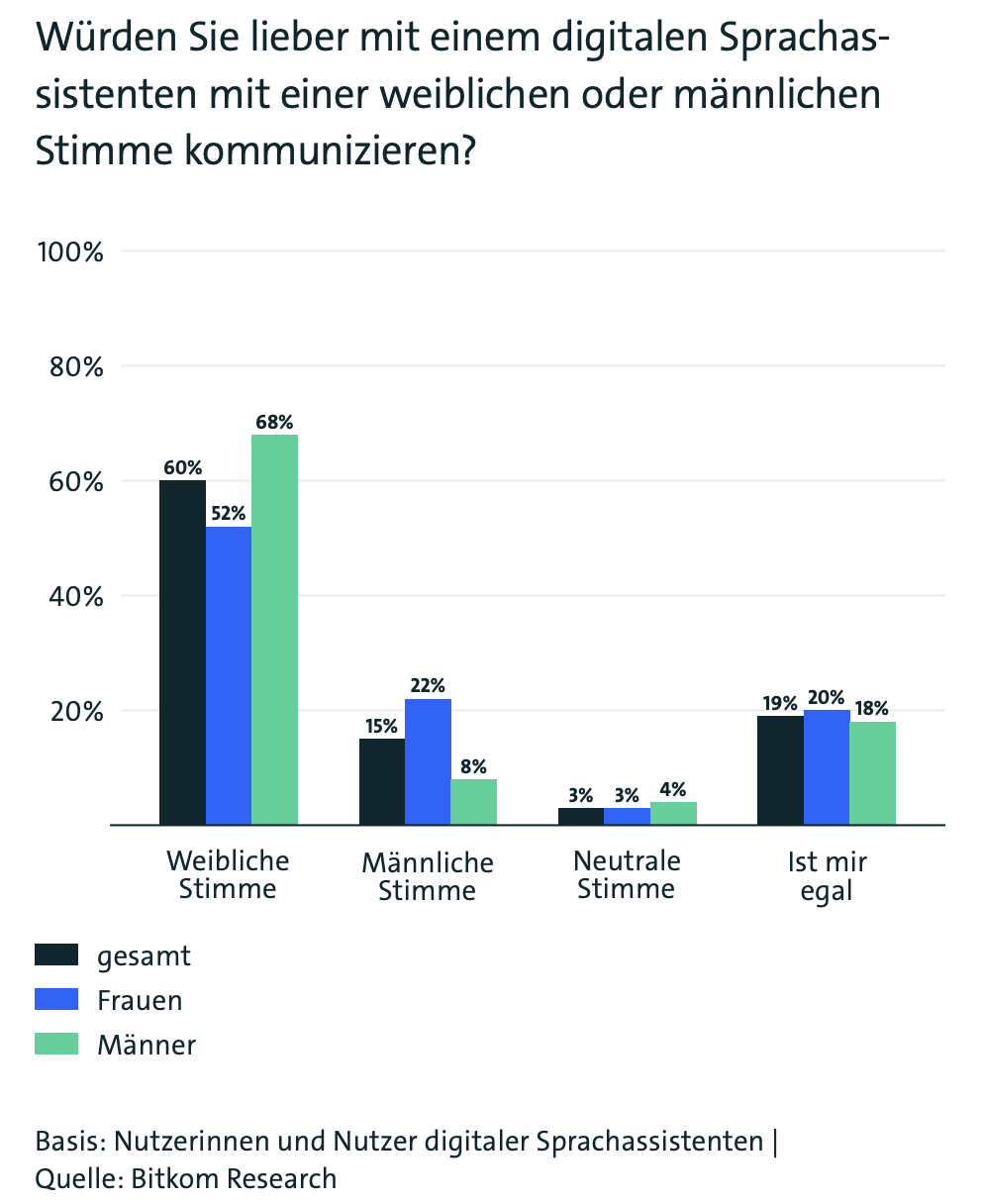
- The female preference: Around 60% of users prefer a female voice.
- The male niche: Only 15% explicitly favor male voices.
- The gender gap: Interestingly, 68% of men prefer a female voice, while the majority of women (52%) also vote for a female counterpart.
Expert insight: We call this the habituation effect. Pioneers such as Alexa and Siri have cemented the expectation that a digital assistant sounds female. The human brain immediately associates this tone of voice with helpfulness.
Psychological archetypes: warmth vs. competence
The choice of voice triggers unconscious stereotypes that have a massive impact on first contact resolution (FCR) and customer satisfaction (CSAT). According to studies by Queen Mary University, two main psychological trends can be identified:
The female voice: The "safe haven"
Female voices are often associated with warmth, empathy, and trustworthiness. In customer service, this is a decisive advantage. When a customer is upset, a female voice has a de-escalating effect. It conveys a sense of care—essential for an excellent customer experience (CX) in complaint management.
The male voice: "Authority"
Male voices, on the other hand, are more often associated with competence, authority, and factual knowledge. In areas with a high degree of technical complexity or security relevance (e.g., enterprise IT support or complex financial transactions), a male voice can reinforce the feeling that "an expert is speaking" and reduce the average handling time (AHT), as explanations are less likely to be questioned.
Strategic decision-making aid: The Context Fit Check
At BOTfriends, we pursue a guided sovereignty approach. This means that we provide the technology, but also offer strategic advice on which agent will achieve the highest acceptance for which process.
| application scenario | Recommended trend | Psychological reason & KPI impact |
|---|---|---|
| complaint management | Female | De-escalation through empathy; increase in CSAT. |
| Technical advice | Male | Higher perceived authority; reduction in queries. |
| Lifestyle & Travel | Female | Inspiring, experience-oriented character. |
| Banking and Insurance | Neutral / Male | Focus on reliability and sober competence. |
| Emergency hotlines | Female | Calming effect in stressful situations. |
Ethical responsibility: breaking down role models
A critical point in modern content strategy: around 40% of users say that purely female assistant systems reinforce outdated gender roles. Women are often pushed into the role of "servant" assistants.
The BOTfriends solution: Diversity through technological freedom:
We promote a progressive brand experience through radical flexibility. Since our platform is model agnostic, you are not limited to the often clichéd standard voices offered by major providers.
- Individual brand identity: Use diverse, non-binary, or strong voices that reflect your brand values instead of reproducing role models.
- Targeted selection: Choose from a virtually unlimited pool of voice models to find exactly the persona that appeals to your target audience on an equal footing—beyond "male/female" patterns.
Enterprise Power: Why orchestration is more important than sound
The best voice is useless if the AI agent cannot solve the problem. Many basic solutions fail when faced with complex processes because they rely solely on single prompts and "hallucinate" when confronted with in-depth queries.
BOTfriends relies on multi-agent orchestration here. While the voice greets the customer, specialized agents work in the background:
- Agent A: Handles authentication.
- Agent B: Performs an API write-back to your system.
- Agent C: Validates the response for compliance.
The voice is just the "body"; the agentic resolution in the backend is what really drives your ROI. A friendly voice combined with flawless problem solving is the gold standard of modern CX.
Conclusion: How to make the right decision
There is no universal answer, but there is a clear strategic recommendation for modern companies:
- Analyze the intent: Is it about empathy (service) or expertise (technology)?
- Brand consistency: Does the voice match your corporate identity?
- Test instead of guess: Use the flexibility of the BOTfriends platform for A/B testing to make data-driven decisions.
Want to experience enterprise power without enterprise overhead? Let's design your first AI agent together, from the perfect voice to deep backend integration.
Still unsure? We're happy to help!
Schedule a non-binding consultation appointment and work with our experts to develop the optimal AI agent strategy for your company.
Frequently asked questions
In regionally based companies, a subtle dialect can create trust. In an enterprise environment, however, standard German (or the respective national language without a strong accent) is safer in order to ensure professionalism and accessibility.
Technically yes, psychologically no. A sudden change is confusing and undermines the consistency of the AI persona. A change should only occur during an explicit handover (e.g., from bot to human agent).
Modern NLP models now incorporate natural pauses. This increases the human touch and reduces the cognitive load on the listener, making communication more fluid.
Use A/B testing to directly compare the performance of different voices: Analyze the containment rate (successful completions by the bot) and measure user satisfaction through targeted queries at the end of the call.