
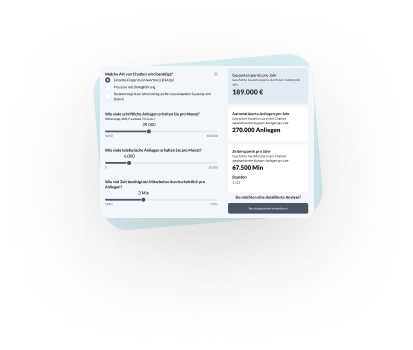
 AI Agent ROI Calculator
 Free training: Chatbot crash course
 Whitepaper: The acceptance of chatbots
(Default) Fallback
–-> Go to BOTwiki
In conversational AI, the (default) fallback is a predefined dialogue path that is triggered when the AI agent cannot process a user’s query or the confidence score is too low.
Back when chatbots still used fixed utterances and user inputs were matched to an intent based on predefined example sentences, the fallback served as a crucial safeguard when none of the predefined topics were recognized. The user was then directed to a special dialogue where a predefined response was displayed to prevent hallucinations.
Today, intent recognition has become significantly more flexible thanks to agent-based logic and large language models. An AI agent can respond contextually, resolve ambiguities on its own, and provide meaningful responses even when a query does not fit exactly into a predefined pattern. The concept of a fallback does not lose its importance, but rather shifts. Instead of a rigid intent handler, it is often sufficient today to specify in the instructions prompt how the agent should proceed in unclear situations.
When the fallback is triggered
If the confidence score for an AI agent’s intent recognition falls below a specified threshold, the request is considered unclassifiable. This triggers the fallback dialog, or the AI agent uses the action instructions stored in the prompt to respond to the situation. Typical triggers include incomplete sentences, topics outside the use case scope, or faulty speech recognition in the voice channel.
Even ambiguous inputs, where multiple topics are equally likely, can trigger a fallback. In modern AI agent platforms, the fallback is not viewed as a dead end, but rather as an active dialogue step that guides the user back onto a productive path.
Creating a Good Fallback Response
An effective fallback response follows a clear structure and avoids generic phrases. A three-part structure has proven effective, as it helps guide the user and keeps the conversation going rather than ending it.
- Clarifying the misunderstanding without blaming the user for the failure.
- A reminder of the AI agent's capabilities, to clarify which topics are covered.
- A specific recommendation for action, such as a sample question, a menu item, or transferring the matter to a colleague.
It is also important to vary the wording. If the same phrases are used every time a fallback occurs, the dialogue comes across as robotic, and trust in the agent drops noticeably. Having several alternative responses that rotate randomly or based on context keeps the conversation feeling natural.
Implications for Voice and Chat
In the voice channel, for example, with a voicebot in hotline triage, the fallback is particularly critical. Speech-to-text consistently produces recognition errors, and background noise and dialects further degrade the input signals.
In chat and email channels, user inputs are generally more concise but longer and cover a broader range of topics. In such cases, additional suggestions—such as topic overviews or quick reply buttons—can be displayed to quickly guide the user to the appropriate feature.
Frequently Asked Questions (FAQ)
A fallback is a specific response triggered by an AI agent when it cannot map a user’s input to a specific intent or when the confidence score is too low. It ensures that the agent responds in a controlled manner rather than guessing or remaining silent. This keeps the dialogue stable and coherent even when dealing with unclear queries.
The fallback is always activated when the user’s request cannot be clearly mapped to a defined topic. Typical examples include incomplete inputs, topics outside the scope of the use case, or recognition errors in the voice channel. Even if several topics are nearly equally applicable, a fallback with a follow-up question may be triggered.
A good fallback response clarifies the misunderstanding, briefly reminds the user of the AI agent’s capabilities, and provides a specific recommendation for action. It is important to use a respectful tone that does not belittle the user. Providing several alternative phrasings prevents the response from sounding robotic if the same issue arises repeatedly.
> Back to BOTwiki