
 AI Agent ROI Calculator
 Free training: Chatbot crash course
 Whitepaper: The acceptance of chatbots
Happy Path
–-> Go to BOTwiki
The happy path describes the ideal and smooth flow of a process or conversation. It is the expected path along which a goal is achieved without deviations or errors. This process path is considered the most efficient and cost-effective, as no unexpected events or problems occur.
In the field of conversational AI, especially with chatbots and voicebots, the happy path represents the most frequently and successfully used interaction paths by users. It is used for the design and optimization of dialogues to ensure that user requests are handled efficiently and that a positive interaction is experienced.
Distinction from the unhappy path and edge case
In contrast to this are the "unhappy paths" or "edge cases." These are alternative scenarios that occur when users deviate from the ideal path. Reasons for this can include incorrect entries, unexpected requests, or technical malfunctions. While the happy path represents the norm (e.g., successful password entry), edge cases cover the exceptions (e.g., forgotten password, incorrect format, system timeout). A clear understanding of both concepts is essential for the development of robust systems. Historically, the focus was often purely on core functionality, but with the rise of UX design, a holistic view of all potential user paths, including edge cases, has become the standard.
How does the Happy Path work?
The Happy Path is not a technical system per se, but rather a design and testing concept based on careful planning and analysis. Its "functionality" lies in the methodical conception and validation of the ideal user flow.
- Target group definition and requirements analysis: The first step is to precisely define the user goals. What does the primary user want to achieve in 80% of cases? For an e-commerce chatbot, this would be, for example, "find and purchase a product."
- User journey mapping: The ideal process is visualized step by step. This often takes the form of flowcharts or user journey maps. Every point of interaction (touchpoint) is defined, from the user's initial inquiry to successful completion.
- Conversational design (conversational AI): In the context of chatbots, conversation flows are designed. For the happy path, this means asking clear questions, offering unambiguous answer options, and requesting the necessary information in a logical order.
4. Prototyping and validation: A prototype of the process is created and tested. In happy path testing is used to check whether the defined ideal path works perfectly from a technical standpoint. Only valid data and expected actions are used for this.
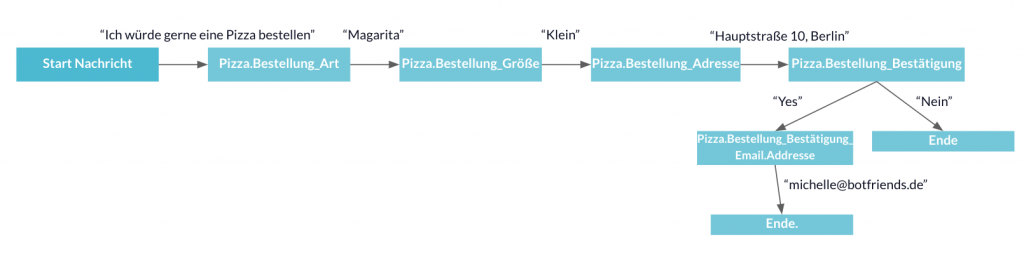
Example for the Happy Path on the Use Case "Order Pizza
This example shows what a "happy" conversation between user and chatbot can look like when ordering a pizza. All information that the user provides to the chatbot can be processed and no misunderstandings arise.
Example for the Edge Case at the Use Case "Order Pizza
This example shows that there can also be great potential for error if the user sends answers that the chatbot cannot process. The graphic below shows that the user enters an address that is outside of Germany. In this case, no delivery can take place. Such edge cases should be considered in advance and mapped in the conversational map. You should ask yourself how to deal with the user in such situations. For example, you can inform the user that you only deliver within Germany or you can give them the option to enter the address again in case of a misunderstanding.

Areas of application and use cases
The Happy Path is a universal concept that applies to all digital interactions in which a user pursues a goal.
- Customer service automation: An AI agent for reporting insurance claims follows the happy path by guiding the user through the required information (policy number, date of claim, description) in a structured manner, without the user interrupting the process or requiring human assistance.
- Automated appointment scheduling: An AI scheduler coordinates a meeting between three participants by comparing their calendars, finding a slot that works for everyone, and sending out invitations, without the need for lengthy back-and-forth correspondence about alternative dates or time zone conflicts.
- E-commerce shopping assistant: A shopping agent accurately identifies a replacement part based on an uploaded photo, checks compatibility with the user's stored device model, and adds the item directly to the shopping cart without the customer having to manually compare technical specifications or contact support.
A well-defined happy path solves the problem of process complexity by minimizing cognitive effort for the user and maximizing efficiency. Industry benchmarks show that reducing the number of steps in the checkout process (an optimized happy path) can increase conversion rates by 20-30%.
Advantages and challenges
Focusing on the happy path offers clear advantages, but also poses challenges if edge cases are neglected.
Advantages:
- Improved user experience
- Higher conversion rates
- Efficient development
- Simpler testing
challenges
- Risk of oversimplification
- Frustration when things don't go as planned
- Incomplete picture
The biggest challenge is finding the right balance: optimizing the happy path without neglecting robust mechanisms for handling exceptions.
Frequently Asked Questions (FAQ)
The happy path describes the ideal, error-free path a user takes to achieve their goal: the expected standard scenario. An edge case, on the other hand, is a rare exception that occurs when the user deviates from the ideal path, e.g., due to an unexpected input or a system error. The happy path is the rule, the edge case is the exception, but it must also be taken into account for a robust system.
From an organizational perspective, you need a clear understanding of user goals and primary business processes. Technically, analysis tools (e.g., web analytics, CRM data) are crucial for identifying the most common user paths. In addition, an interdisciplinary team of UX designers, product managers, and developers is necessary to holistically design and validate the process, from the initial sketch to the final test.
The duration depends heavily on the complexity of the process. A simple process such as newsletter registration can be optimized in a few days. A complete checkout or onboarding process can take considerably more time. Factors include the quality of the existing data, the complexity of the system integration, and the scope of the A/B testing required to validate the improvements.
The costs primarily include human resources for analysis, design (UX/UI), technical development, and testing. License costs for analysis or A/B testing tools may also be added. The total cost of ownership (TCO) should be weighed against the expected return on investment (ROI), which results from higher conversion rates, increased efficiency, and improved customer satisfaction.
A development focused purely on the happy path is not recommended. The best approach is holistic "journey optimization." This involves optimizing the happy path as priority 1, while also identifying the most common unhappy paths and providing robust error handling and alternative solutions. The goal is a fault-tolerant system that reliably guides users to their destination even when they deviate from the ideal path.
> Back to BOTwiki