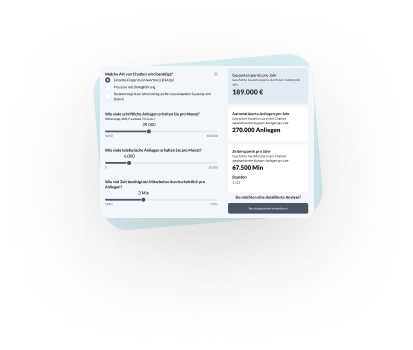
 AI Agent ROI Calculator
 Free training: Chatbot crash course
 Whitepaper: The acceptance of chatbots
Although the acceptance of chatbots by customers is growing, they still often appear to offer a poor user experience. The reason for this is that the full potential of the technology can only be exploited with continuous and targeted optimization. For this, however, it is essential to think about how the performance of the chat or voicebots can be evaluated even before the go live. However, most companies have not defined any goals against which they can measure the success of their bots.
This blog post will therefore describe established goals and KPIs from chatbot projects. This is because in most cases, the intentions in companies are similar. Usually, they include goals such as the internal impact and efficiency of such systems. But also user:internal acceptance and customer:internal satisfaction play a major role.
Internal impact and efficiency: Do virtual assistants help us to save resources and work more efficiently?
The following KPI's can be used to determine whether the use of a virtual assistant can save resources or make work processes more efficient:
Number of active users
How many individual users have interacted with the chatbot? It should also be measured whether the number of customers with whom employees communicate has been reduced by the use of chatbots.
Number of conversations/sessions handled by the bot
A user can have multiple conversations or sessions with a virtual assistant. Analytical systems count a new session after a certain period of inactivity (e.g. 15 min).
Human Handover Rate
How often does the chatbot hand over the conversation to an employee? How often do users explicitly ask for a real person to talk to? The better the virtual assistant is trained, the less conversations need to be handed over to a real person.
Percentage and number of default fallback intents/error messages
This metric shows how often the chatbot was not able to give the desired answer. Often, answers such as "I'm sorry, I didn't understand that" are sent. If the error message rate is very high (20% or more), virtual assistants need to be trained and checked to see if the required information is available.
Number of messages processed outside business hours
Being able to offer customers good service outside business hours is a clear competitive advantage. Therefore, it should be measured how many queries the chatbot can answer independently at these times.
Feedback on calls outside business hours
At the same time, direct feedback from users should be monitored during this period. For example, if users write that the information provided by the chatbot was not helpful, the answers must be revised.
Ø-Confidence Score overall or per conversation
Overall, how confident is the system in giving correct answers? The confidence score describes whether the system was 100% sure that the answer matched the question or only 20%. The more training data the system has, the more confident the answers will be.
Number of agent:in interactions due to active intervention
The sentiment score (see below) can be used to determine whether a conversation with the chatbot is on target. If this is not the case, employees can proactively take over the conversation and thus prevent disgruntled users from leaving.
Degree of target fulfilment
This metric provides valuable information on the success rate of a particular action performed with the help of the chatbot. For example, if the user has successfully gone through a certain process such as an order, cancellation or a change of master data. Otherwise, calls to certain target pages can also be measured.
Ø Duration of the conversation
How long does it take the assistant to give the users what they were looking for? This metric allows to evaluate the average duration of the interactions between the chatbot and its users. The value will vary greatly from case to case: a chatbot that solves more complex processes will need a much longer dialog than one that gives simple FAQ answers. This KPI helps quantify the time saved by customers:and employees. If the goal is also higher user adoption, you will know how much time users spend with the virtual assistant.
Number of users/sessions per channel
Virtual assistants can run on multiple platforms simultaneously. For example, a chatbot can be integrated on the homepage as well as on the Facebook Messenger channel. In addition, the content can also be transferred to voice assistants. Here, it should be measured on which channel most users interact and to what extent the type of interaction differs. For example, is the degree of target fulfillment higher?
Customer satisfaction: Do chatbots help our users solve their problems?
Whether users rate a chatbot or voicebot as helpful depends on whether it was able to help them solve their problems. The following three KPIs enable companies to assess how helpful users rate their chatbots.
Net Promoter Score (NPS)
Would users recommend the virtual assistant to others? This question is also used by default at various other touchpoints to measure customer satisfaction.
Ø-Sentiment score overall or per conversation
This score ranges from -1 (dissatisfied users) to 1 (very satisfied users) and provides information about the mood of the users with the help of machine learning and text analysis. For example, if insults are used against the chatbot, the system reacts with a negative sentiment score. Human agents can intervene accordingly and de-escalate the conversation.
Exit feedback surveys
Here, the overall effectiveness of the bot is evaluated from the perspective of the user experience. Users are asked to rate their experience with the chatbot. This provides a company with valuable information on the quality of the virtual assistant. This can be done by asking questions such as "Was this answer helpful?", "Could I solve your problem? - Yes or no" as soon as a certain point in the conversation is reached.
User:innacceptance: Do our users want to be helped by virtual assistants?
Virtual assistants offer users many advantages. However, not all users want to communicate with a chatbot. How well this is accepted can be determined with the help of the following KPIs:
Offence rate
This shows how often users insult the chatbot. For this, a dedicated intent with training phrases of various example insults must be created. If this intent is played out disproportionately often, the cause should be searched for.
Ø-Number of messages per conversation
This indicator can be used to determine how many questions are asked before the chatbot outputs the requested information. It also describes how much time the user:s spent writing. However, it should be noted that the ideal number of questions required varies significantly depending on the use case.
Initiation of the human handover within a certain number of user messages
If users demand to speak to a real employee immediately, this can mean that acceptance is very low, because they do not want to interact with the bot.
Exit rates
Show at what point in the conversation path users have left the conversation and highlight the areas where the bot loses the users' attention.
Ø length of the messages
The shorter the requests, the more likely users are to engage in a conversation with a virtual assistant. Messages that are too long and have different contexts are more difficult for the system to understand and process.
Retention Rate
How often do users return to the chatbot within a certain period of time? This KPI describes how successful interactions with the virtual assistant have been. If methods such as notifications in messaging platforms or ads are used to get users to interact with the chatbot again, this should be considered in a differentiated way. The number of users who come back on their own should be tracked. If the chatbot offers real added value, the probability is all the higher.
If a chatbot is not well received by the users, this can have various reasons: For example, the target group may not yet be familiar with the use of virtual assistants. Or the chatbot has been poorly trained and using it is tedious and frustrating. A lack of user:inside acceptance does not have to mean that the use of a chatbot does not make sense.
There are countless metrics or KPIs that ultimately provide information about the success of chat and voicebots. It is important to be clear from the beginning about the problem to be solved and the goals to be achieved. Only on this basis can the right key figures be selected. Because the recipe for success lies in optimisation. Really good chatbots are created when those responsible put resources into the maintenance and operation of the virtual assistants. After all, a one-off development is not enough. The good thing, however, is that training a chatbot is only very costly at the beginning. Over time and from a certain level of training, the effort is reduced immensely.
To make your work easier, we have compiled a checklist with the most important KPIs.
Frequently asked questions
Various KPIs are decisive for the success of a chatbot. These include the automation rate, which indicates how many requests the chatbot solves independently, and the human takeover rate, which shows how often a handover to a human employee is necessary. Positive and negative user ratings and the number of conversations reflect user satisfaction and acceptance. The conversion rate, i.e. the achievement of predefined goals in the chat, and the degree of goal fulfillment are also important indicators. The BOTfriends X platform enables companies to track these metrics precisely in order to make data-based optimizations and continuously increase the efficiency of the chatbot as a central chatbot success factor.
The user acceptance of a chatbot depends largely on its quality and transparent communication. Important success factors include setting realistic expectations for the user, natural language interaction and the use of multimedia elements in the responses. The company should also enable an easy handover to human employees. A positive user experience is promoted by personalization and speed, as 60% of online shoppers switch providers after a bad experience (Metorspace, 2024). The BOTfriends X platform helps companies design chatbots with natural language, multimedia content and seamless handovers to maximize user satisfaction and build trust.
Modern AI technologies such as generative AI and powerful knowledge bases are key success factors for intelligent chatbots. A knowledge base serves as the 'brain' of the bot by importing and automatically processing company content such as documents and websites. Generative AI enables the chatbot to understand more complex queries, formulate more diverse and human responses and continuously develop itself. The BOTfriends X platform offers unlimited knowledge bases, a smart URL crawler and the choice between different Generative AI models such as Azure OpenAI and Google Gemini. This leads to smarter, context-aware answers and reduces 'hallucinations', which significantly increases the effectiveness of the chatbot.
The ROI of a chatbot is evaluated by analyzing the costs and benefits. The costs include implementation and maintenance, while the benefits include cost savings in customer service, relief for employees and improved customer satisfaction. A successful chatbot automates routine requests and is available 24/7, increasing productivity and service quality. Companies can also use lead generation and increased sales as success factors. BOTfriends offers an ROI calculator and personal consultations to help companies make a detailed calculation. The BOTfriends X platform charges according to the 'solved customer issue', not according to message volume, which enables a transparent and value-oriented cost structure.
What are important success factors beyond KPIs for the go-live and long-term operation of a chatbot?
In addition to pure KPIs, strategic success factors are crucial for the entire chatbot lifecycle. This includes a well thought-out marketing strategy before the go-live - be it a 'loud' or 'silent' release - and effective expectation management among users. Careful selection of the release date, taking into account seasonal events, is also important. On go-live day, comprehensive support is essential to resolve unforeseen issues quickly. In the long term, continuous training and maintenance of the chatbot is a critical success factor. BOTfriends supports companies with dedicated success managers, personal onboarding and individual system integrations for a smooth start and sustainable optimization.