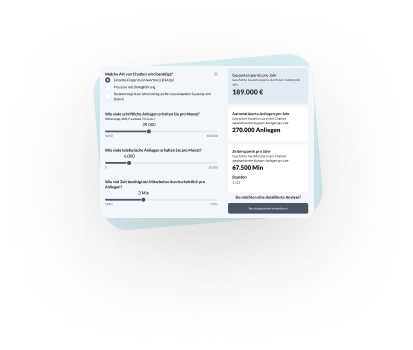
 AI Agent ROI Calculator
 Free training: Chatbot crash course
 Whitepaper: The acceptance of chatbots
Voiceand chatbots offer a wide range of possibilities in marketing. For example, they can provide traditional product advice, facilitate purchases through the voice or chatbot, or send reminders about products still in the shopping cart after an abandoned purchase. With a little creativity, however, voice and chatbots can also be used for brand building or to create a brand experience for customers.
In the following part we would like to show you with examples how Conversational Marketing can look like:
- Tommy Hilfiger: Product advice
- Madison Reed: Omni Channel Marketing
- Sephora: Advice and appointments
- Cover Girl: Collaborations with Influencers
- Absolut Vodka: Product launch and gamification
Tommy Hilfiger: Product advice with a chatbot
The fashion brand Tommy Hilfiger offers its customers personal fashion advice via its Facebook Messenger chatbot.

Users can view the current collections or select items of clothing directly from the catalog and add them to their shopping cart. They also have the option of getting advice from the chatbot and putting together a complete outfit. To do this, the chatbot asks them questions and filters out the right products based on the answers. For example, if the user indicates a preference for muted colors, the chatbot selects an outfit in muted colors.
Once the selection has been made, the chatbot forwards the user to the Tommy Hilfiger website, where the items of clothing are already stored in the shopping cart. The users can therefore go directly to the checkout and buy the products. Of course, it would also be possible for customers to buy the goods directly during the chat and not have to leave the Messenger at all.
Madison Reed: Omni Channel Marketing with a Chatbot
Madison Reed is an American brand of hair care products. To help customers choose the right product, the company offers a quiz on its website. In this quiz, customers answer 12 questions and are then recommended the right color with the help of a color matching algorithm. Alternatively, they can also get advice from customer service.
During these conversations, it was discovered that many customers prefer to send a picture of themselves via email or live chat to describe their hair color. The company therefore decided to accommodate its customers and incorporate this behavior organically into the customer journey.
The company wanted to retain the conversational character and take advantage of customers' habit of taking selfies.
Madison Reed chose Facebook Messenger, the most popular messenger in America, as the channel. A chatbot was implemented here, which on the one hand has access to the company's algorithm. It is also equipped with image recognition software. Users can now start a conversation with Madi via Messenger and upload a selfie. Based on the picture and a few other questions, the chatbot can then suggest a hair color. If they are happy with the suggestion, customers are redirected to the product page via a link, where they can purchase the hair dye directly.
The Madi chatbot is a good example of how existing marketing measures can be made accessible to customers via an additional channel and a purchasing experience tailored to their needs and preferences can be created.
Sephora: Advice and appointments with a chatbot
The Sephora chatbot works similarly to Madison Reed. Using uploaded images, the chatbot recommends make-up and other beauty products.


Users can also use the chatbot to book an appointment for a personal consultation in the store. To do this, the chatbot first asks what they would like an appointment for and in which city and then suggests available appointments. Once the customers have selected an appointment, the chatbot then asks for the contact details and books the appointment for the user.

Collaborations with influencers
The make-up brand Cover Girl has entered into a cooperation with influencer Kalani Hilliker for its chatbot. The aim is to distribute discount coupons to users via the chatbot, which can then be redeemed in the Cover Girl online store. The aim is also to build stronger brand loyalty.
The special thing about this chatbot is that it imitates the personality of the 16-year-old Hilliker. To make this possible, the bot's choice of words and tonality were carefully adapted to the influencer.
To prevent fans from thinking that they are actually writing to Hilliker and to avoid irritation, the bot's welcome message humorously points out that the chatbot Kalanibot thinks it is Kalani himself.
In order to create an incentive for users to stay in the chat long enough to receive a discount coupon for Cover Girl from the chatbot, they are offered the chance to ask the real Kalani a question.
The cooperation with the influencer and the chatbot was a complete success for Cover Girl: on average, 17 messages were sent by users in one conversation and users received a coupon from the Kalanibot in 48% of conversations.

Gamification for the marketing of a new product
To market a product launch regionally, the Vodka Absolut brand decided to use a chatbot. The product in question was the new limited edition The product was the new limited edition Absolut Unique collection, which was to be presented and promoted at a party in Argentina.
The only way for consumers to get a ticket to this exclusive party was to contact the bouncer Sven via WhatsApp and convince him that they deserved to attend the party. The trick here was that Sven was a chatbot.
Within 3 days, Sven interacted with over 600 users and received over 1,000 videos, images and audio clips in the messages. The users got very creative: they sang well-known songs or used movie scenes in which they had changed the lyrics to justify why they deserved a ticket. Videos with tests of courage were also sent to the chatbot, with which the users wanted to earn the tickets. Others again relied on their negotiating skills and tried to convince Sven with a conversation.
But this is not the only marketing campaign where Absolut Vodka has relied on a chatbot:
In America, Facebook users in the cities of Denver, New York, Chicago, and Dallas can contact the Vodka Absolut chatbot and request a coupon for a free drink at a nearby bar.
To this end, potential customers are first shown an advertisement on Facebook:

As soon as Facebook users click on the "Send Message" button next to the ad, they are redirected to Facebook Messenger, where the Absolut Bartender bot offers them a voucher.

As soon as they confirm that they would like to receive a voucher, the bot asks them which city they are currently in. Based on this information, the bot then suggests selected bars and asks which bar the user would like to go to.

The chatbot then lets the user choose a drink.

Once these questions have been answered, the chatbot sends the customer their voucher.

These were five examples of how voice and chatbots can be used for conversational marketing.
If you would like to know more about this topic, why not pick up our white paper "Conversational Commerce"? In it, we show you how you can use voice and chatbots for marketing along the entire customer journey.