
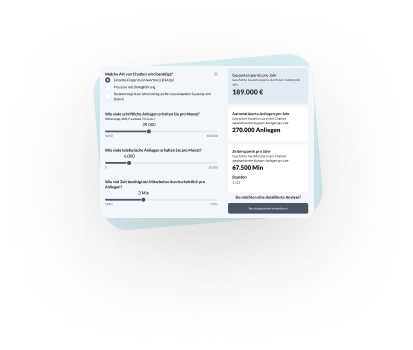
 AI Agent ROI Calculator
 Free training: Chatbot crash course
 Whitepaper: The acceptance of chatbots
Conversational office
–-> Go to BOTwiki
A conversational office, also known as a conversational workplace, refers to a business environment in which a large portion of internal communication and service processes is handled through conversational systems. Instead of navigating through intranet menus, self-service portals, or ticket forms, employees speak or write directly to an AI agentwho understands their requests, retrieves data from the appropriate backend systems, and initiates the necessary actions.
This creates a new communication standard for companies that brings together HR, IT support, and facility management on a unified conversational platform.
What Makes a Conversational Office
A conversational office is more than just a single FAQ bot on the intranet. It combines multiple AI agents, each of which covers a specific area of expertise—such as human resources, IT services, travel management, or office logistics. Through multi-agent orchestration, these agents access shared identities, permissions, and knowledge sources, and seamlessly forward inquiries to the appropriate specialist agent.
Technically, a Conversational Office is based on a unified conversational AI platform that integrates voice, chat, and email under a single logic. Knowledge AI ensures that internal policies, manuals, and tool documentation are accessible without employees needing to know which system contains the answer.
Typical areas of application within a company
The applications range from recruiting to office management. A Conversational Office brings these use cases together into a single, unified conversational experience instead of spreading them across ten different tools.
- HR and Recruiting: Job searches, application status, vacation requests, pay stubs, and onboarding steps are handled through the dialog.
- IT Support: Password resets, device orders, software approvals, and trouble tickets are handled via AI workflows and escalated as needed.
- Office services: Room reservations, cafeteria menus, shuttle schedules, visitor registration, and taxi orders can all be handled via self-service.
- Knowledge Access: Employees ask about policies, processes, or contract terms and receive answers backed by reliable sources.
Implications for Voice and Chat
In the Conversational Office, the voice channel is playing an increasingly important role. An internal service hotline that used to be handled by a traditional IVR system can now be managed by a phonebot that immediately understands the issue and directs the caller to the right place without a menu of button presses. Traditional IVR is a body without a brain. AI-native voice with multi-agent orchestration, on the other hand, combines natural language understanding with actual task processing. An employee who needs to reset their password while on the go can do so over the phone instead of in a browser.
In a chat, such as via Microsoft Teams, Slack, or an internal web widget. Does the voice experience complement intent-based dialogues featuring attachments, buttons, and structured responses. Email inquiries sent to service inboxes can also be automatically classified and answered by the same AI agent, ensuring a consistent knowledge base across all channels.
Conversational Office in Multi-Agent Setups
A productive Conversational Office rarely consists of a single all-around agent. Hybrid intelligence—combining rule-based process logic and generative models—forms the brain, while individual specialized agents act as the body for HR, IT, or facilities. An orchestration layer determines which agent handles a request, when a human employee takes over, and what information flows between the systems. This allows the Conversational Office to scale with the company’s structures, rather than managing each department in an isolated tool.
> Back to BOTwiki