
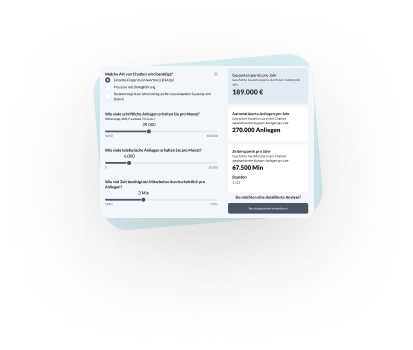
 AI Agent ROI Calculator
 Free training: Chatbot crash course
 Whitepaper: The acceptance of chatbots
Conversational Map / Conversational Flow
–-> Go to BOTwiki
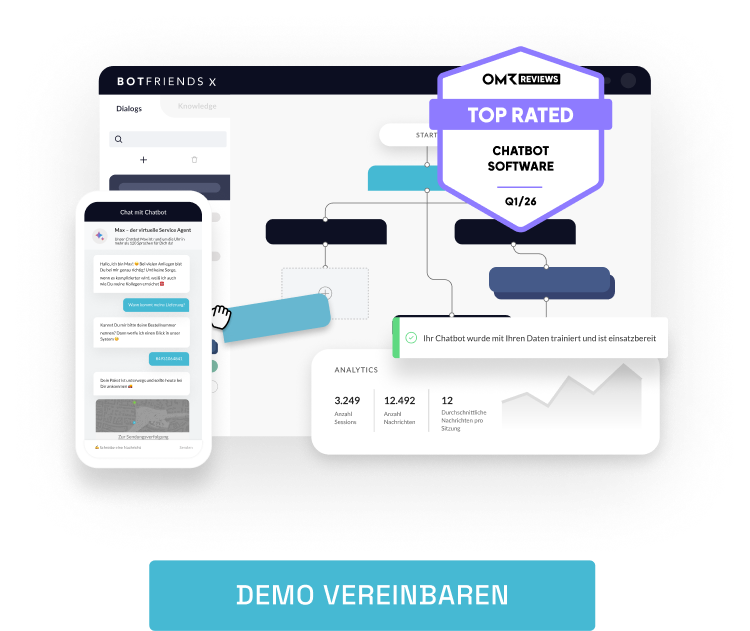
The conversational map, often referred to as the conversational flow, is a visual representation of the dialogue between a user and an AI agent. It maps out all possible paths a conversation can take: from the initial interaction through content-based branches to error cases and the handoff to a human agent. The map thus serves equally as a design tool, a basis for stakeholder alignment, and a blueprint for technical implementation.
Especially in more complex conversational AI projects, it serves as the foundation for ensuring that voice, chat, and email dialogues are not created haphazardly, but are deliberately designed. Without this visualization, the dialogue design remains hidden within text documents, making it difficult to coordinate effectively between business units, design, and development.
Why a Conversational Map Is Indispensable
A conversational map provides clarity on which issues an AI agent handles and how it responds to typical inputs. Stakeholders from business units, IT, service, and marketing gain a shared view of all conversation threads and can identify gaps, inconsistencies, or unclear wording early on. This allows them to add missing content, address weak points, and eliminate potential barriers to use before they arise in live conversations.
A good map clearly distinguishes between happy paths and edge cases. The happy path describes the ideal scenario, in which a request is immediately understood and resolved. Edge cases show how the agent responds to unexpected inputs, misunderstandings, or missing information. This distinction is essential for ensuring that conversational AI remains reliable in real-world scenarios and doesn’t just perform well in demos.
Structure and typical stages
The creation of a conversational map follows typical steps that span from the greeting to the end of the conversation. This process takes into account the media used, the features, and the desired style: a click-based bot, a free-text dialogue, or a hybrid of the two.
- Welcome message including a greeting, tone of voice, and introduction of the agent, along with a brief explanation of how the system works and the topics covered.
- Content levels with subject-specific branches, such as by intents.
- Error messages and prompts for entries with a low confidence score.
- Back button and navigation links to return to previous steps.
- Handover to a human employee if Knowledge AI or AI workflows are insufficient or if the issue cannot be assigned.
Based on this, dialog logic, buttons, dynamic content, and backend calls are linked together. This creates a consistent blueprint that is later directly implemented in the platform.
Implications for Voice and Chat
In the voice channel, for example, with a voicebot or a phonebot in hotline triage, the conversational map must be designed with particular care. Voice inputs are shorter, often ambiguous, and contain recognition errors from the speech-to-text step. Traditional IVR systems create rigid menu trees without semantic understanding. AI-native voice with multi-agent orchestration, on the other hand, can flexibly switch between specialized agents based on the map, maintain context, and ask targeted follow-up questions without forcing the caller through a series of options.
In chat and email channels, the focus is more on structure and readability. Buttons, cards, and structured lists complement the free-form text, and longer responses can be broken down into several steps. The Conversational Map ensures that the same technical logic remains consistent across all channels. Only the presentation adapts to the respective medium.
Conversational Map in Multi-Agent Setups
In modern conversational AI architectures featuring multiple specialized AI agents, the conversational map serves as the overarching choreography. It displays not only individual dialogues but also the handoffs between agents: from the triage agent to contract management, and from self-service to escalation. Hybrid intelligence is explicitly modeled here by clearly marking the points at which the agent makes autonomous decisions and the points at which reliable business logic is used.
The map is transferred from the design phase to the platform, serves as a reference for optimizations during operation, and provides the foundation for seamlessly adding new use cases without disrupting existing workflows.
Frequently Asked Questions (FAQ)
A conversational map is a visual representation of the dialogue flow between users and an AI agent. It shows all relevant paths, from the greeting through subject-specific branches to error handling and handoffs, and serves as a shared working document for the design, business, and development teams.
These terms are often used interchangeably. In practice, the conversational map provides a general overview of all possible dialogues, while conversational flow typically describes the specific progression of a single interaction. Both perspectives complement each other and are combined in a structured document.
Typical examples include welcome messages, onboarding, levels of technical content, error and query logic, back navigation, and the handoff to a human agent. In addition, media, buttons, and integrated features such as email sending or backend queries are highlighted.
The map is particularly important for voice and phonebot projects because voice dialogs are less forgiving than chat. It helps define concise prompts, clear follow-up questions, and logical escalation paths. This results in a dialogue that feels natural and can also be reliably orchestrated between specialist agents and human teams in multi-agent setups.
> Back to BOTwiki